The ASU+GSV Summit 2026 Shared Institutions' Anxiety in the Age of AI
April 20, 2026
IBL News | San Diego
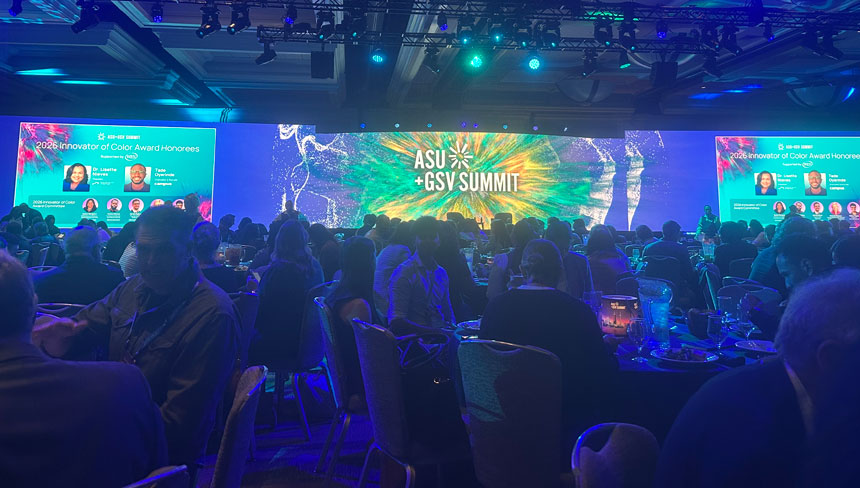
Over 7,000 people attended the ASU+GSV Summit 2026 in San Diego from April 12-15 to discuss the future of learning in a landscape reshaped by AI fever.
“We’ve been talking about personalized learning for two decades,” Reed Hastings, the Netflix co-founder, told a packed ballroom of thousands of education leaders. “AI finally makes it real. The question is whether we’re brave enough to redesign our institutions around it.”
The ASU+GSV Summit 2026 made clear that education’s technological transformation is inevitable. What remained uncertain is whether it would be intentional, equitable, fast, and pedagogically sound.
That blend of urgency and possibility defined the ASU+GSV Summit 2026, which concluded Wednesday after four days that felt less like a conference and more like a referendum on education’s immediate future.
ASU+GSV Summit 2026, one of the world’s largest edtech gatherings, brought together 1,000 education technology companies, 800+ speakers, and delegates from 65 countries to discuss “how the world’s best ideas in learning can find capital, partners, and scale, bringing the venture ecosystem and higher ed transformation,” in the words of Deborah Quazzo, co-founder and managing partner of GSV Ventures, during opening ceremonies.
On day one, the session “Stop Buying AI Like It’s Software: Why Co-Creation Wins” drew particular attention. A panel of district leaders and AI company founders made the case that procurement must evolve — from licensing transactions to genuine partnerships where educators shape product development.
“We got burned buying ‘personalized learning’ platforms that were one-size-fits-all,” said one superintendent on the panel. “This time, we’re demanding co-design from day one, or we’re walking.”
The afternoon’s “Higher Ed Crow’s Nest” brought Arizona State University President Michael M. Crow — the Summit’s institutional partner and higher education’s most vocal evangelist for radical accessibility — into conversation about ASU’s AI strategy. Crow revealed that ASU now has AI teaching assistants in over 400 courses, adaptive assessment in 60 programs, and a forthcoming “Universal Learner Record” that will track competencies across formal and informal learning.
“The credential is dying,” Crow declared. “What matters is what you can do, and we can now measure and verify that at scale. Universities that don’t accept this will become museums.”
On Tuesday, the second day of the conference, the Summit’s central topic was how AI will transform education and whether we’re ready.
The main stage featured a parade of demonstrations — AI tutors that adapt to learning styles, AI admin tools that automate enrollment and advising, AI content generators that produce personalized curriculum. Synthesia showed AI-generated video lecturers. HeyGen demoed real-time translation with lip-sync. Magic School presented AI lesson planning that can generate a week’s worth of materials in minutes.
“This is either going to be the biggest thing to happen to education since the printing press, or the biggest disaster since we let tech companies dictate school reform in the 2010s,” said to IBL News one panelist during “The AI Revolution Lab” track, summing up the room’s mood.
Former Secretary of Commerce Gina Raimondo delivered one of the week’s most-cited talks, connecting AI adoption in education to national competitiveness. “China is training 5 million AI engineers,” she warned. “We’re debating whether college students should be allowed to use ChatGPT. We need to wake up.”
Kirsten Baesler — the newly appointed Assistant Secretary of Education for Elementary and Secondary Education — drew the longest applause with a more cautionary message. “AI literacy isn’t optional,” Baesler said. “But neither is critical thinking about AI. We need students who can use these tools and question them. That requires educators who understand both the technology and its limitations. Right now, we’re not investing nearly enough in teacher preparation for this moment.”
The afternoon’s “Educator x Entrepreneur Exchange” brought 200 teachers and principals into structured conversations with founders — a format designed to bridge the persistent gap between what gets built and what actually works in schools.
One teacher from Chicago summed up the prevailing sentiment: “I don’t need another AI grading tool. I need AI that helps me see which students are struggling before they fail, and why. Build that.”
Wednesday’s closing sessions adopted a more reflective tone. With deals negotiated, pitches delivered, and business cards exchanged, attention turned to meaning-making.
“Education is the only business where we celebrate making things harder,” will.i.am — who holds a professorship at ASU — said. “Imagine if I made music that way. This song is too accessible; let’s make it more painful to appreciate. We wouldn’t tolerate it. Why do we accept it in learning?”
Former Education Secretary Arne Duncan, alongside state leaders and advocates, remarked during the session “Politics, Policy & State Power” that, despite the Summit’s innovative energy, actual policy movement remains slow, uneven, and increasingly polarized.
“We have the tools to revolutionize learning,” Duncan observed. “What we lack is political will and imagination. Those don’t scale through venture capital.”
Themes That Dominated
– 1. AI’s Uncomfortable Ubiquity. AI was a present reality demanding immediate response. Every major theme track featured AI sessions. Sponsors demonstrated AI products. Speakers referenced AI capabilities. Even sessions about other topics (early childhood education, career readiness, higher ed finance) circled back to artificial intelligence.
“Five years ago, we were asking if AI would matter in education,” said one longtime attendee. “Now we’re asking how quickly we can adopt it without breaking things. That’s a huge shift.”
The AI Revolution Lab track offered an unflinching look at both promise and peril — from algorithmic bias in admissions to the existential question of what teaching means when content transmission can be automated.
Victor Riparbelli of Synthesia and Connor Zwick made compelling cases for AI-generated instructional content. But critics pushed back: Does efficiency in content creation lead to better learning, or just more content?
– 2. Workforce Transformation as Existential Threat and Opportunity
The Summit’s “Career-Connected Learning” track reflected a growing consensus that the traditional academic pipeline is breaking down. With employers increasingly skeptical of degrees, students drowning in debt for credentials of diminishing value, and skills gaps widening, the conversations had an edge of desperation.
“We’re not preparing students for jobs,” said Tade Oyerinde, Chancellor and Founder of Campus. “We’re preparing them for employment models that no longer exist. The entire infrastructure needs rethinking.”
Sessions on apprenticeships, work-based learning, micro-credentials, and competency-based education drew packed rooms. The message: Colleges that cling to seat time and credit hours face irrelevance. Companies that demand degrees while complaining about skills gaps are part of the problem, attendees agreed.
Johnny C. Taylor Jr. of SHRM showed that 45% of major employers have dropped bachelor’s degree requirements for roles that previously demanded them.
– 3. Equity in an Age of Acceleration
The “Innovators of Color” and diversity-focused sessions grappled with a question: Does technology accelerate equity or calcify advantage?
On one hand, AI tutors could provide personalized support to under-resourced students. Digital credentials could bypass gatekeeping institutions. Open educational resources could democratize access.
On the other hand, AI training data reflects historical biases. Access to cutting-edge tools skews toward wealthy districts. The “digital divide” now includes not just connectivity but AI literacy.
Adrián Ridner, founder and CEO of Odilo, presented data from learning platforms across Latin America showing that when properly deployed, digital tools do narrow gaps — but only with intentional equity design, not as an automatic byproduct.
“Technology is an amplifier,” said Byron Auguste, founder/CEO of Opportunity@Work. “It amplifies intention. If your intention is equity, tech can accelerate it. If your intention is efficiency that happens to advantage the already-advantaged, tech will accelerate that too. There’s nothing neutral about it.”
Notable Voices
– ASU’s Michael M. Crow offered a vigorous defense of the research university’s continued relevance — but one predicated on radical evolution.
– Western Governors University President (and Summit sponsor) representatives made the case for competency-based, online-first models.
– Michael Hansen (Cengage CEO) discussed the textbook publisher’s transformation into a “digital learning company.”
– Guild Education talked about employer-as-educator.
– Study.com showcased alternative pathways to degrees.
– Greg Lukianoff (FIRE President & CEO) on free speech and intellectual diversity on campus, arguing that AI tools might actually improve discourse by helping students engage with opposing viewpoints more effectively
– Sian Beilock (Dartmouth President) on the neuroscience of learning and why understanding how brains process information should shape AI deployment in education
– Arthur Levine on higher education’s “death spiral” of cost and the urgent need for sustainable models
– Kate Eberle Walker (PresenceLearning CEO) on special education technology and why equity requires designing for edges, not averages
– Greg Hart (Britebound CEO) on early childhood education and the particular dangers of AI in the developmental years when human interaction matters most
Sponsor Lineup
Traditional publishers (Pearson, Cengage, McGraw-Hill) stood alongside tech giants (Google, Microsoft, Amazon Web Services), philanthropies (Gates, Walton, Chan Zuckerberg Initiative, Lumina), workforce-focused organizations, and a proliferation of AI companies.
The presence of consulting firms (BCG, Accenture, McKinsey) reflected higher education’s increasing reliance on external expertise — a trend critics see as abdication of leadership, defenders see as a necessary external perspective.
The presence of investment banks and private equity (Goldman Sachs, Morgan Stanley, Barclays, Vistria Group) signaled that edtech remains an attractive sector despite recent venture capital pullback in other industries.
And the diversity of institutional sponsors — from ASU and WGU to National University and University of Phoenix — showed the blurring lines between traditional non-profit higher education and alternative models.
Policy Sessions Revealed Significant Headwinds
– Regulatory Uncertainty: With federal AI regulation still nascent and state approaches wildly inconsistent, companies and institutions struggle to know what compliance looks like.
– Student Privacy: New tools mean new data, raising questions about consent, ownership, and commercial use that current regulations don’t adequately address.
– Accreditation Lag: Innovation outpaces approval processes, creating friction between what’s possible and what’s permissible.
– Funding Volatility: Philanthropic enthusiasm for education technology faces donor fatigue; government funding remains politically fraught; outcome-based models create sustainability challenges.
State leaders at the “State Power” sessions revealed wide variation: Some states are aggressively promoting AI adoption, while others are banning or restricting it. Some are creating new credential pathways, others are defending traditional structures.
“We don’t have a national education system; we have 50 state systems,” one panelist noted. “That’s usually our weakness. In this moment of experimentation, it might be our strength.”
In his closing remarks, will.i.am said: “We can automate a lot of things. We can’t automate caring. We can’t automate inspiration. We can’t automate the moment when someone sees themselves differently because a teacher believed in them. If we lose that in the race to innovate, we haven’t transformed education. We’ve just made it more efficient at the wrong things.”
Discover more
IBL News is funded by the New York-based, family-owned company ibl.ai. Our stories adhere to the highest ethical standards in journalism and are available to news syndication agencies.