Stanford's Index Report Notes that AI Has Surpassed Human Capabilities in Language Understanding
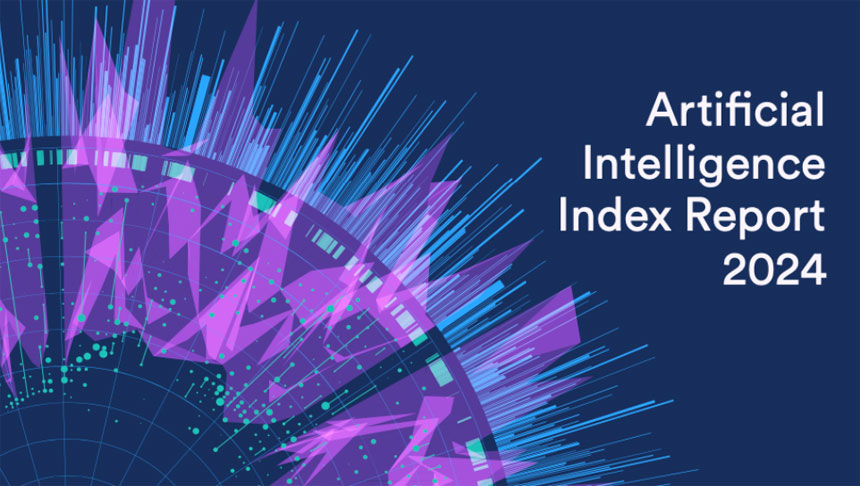
Stanford University's Institute for Human-Centered Artificial Intelligence released its 2024 AI Index Report last month.
The document synthesizes AI-related data, developing a nuanced understanding of this field regarding innovation, investment, regulation, and social impacts.
This year’s report documents AI’s astonishing progress on tasks such as image classification and language understanding, where it has surpassed human capabilities. Humans maintain an edge in other areas, such as advanced mathematics and visual commonsense reasoning and planning. It seems it’s only a matter of time before it catches up to humans on these skills.
The AI Index is recognized globally as one of the most credible and authoritative sources for data and insights on AI. Previous editions have been cited in major newspapers, including The New York Times, Bloomberg, and The Guardian, have amassed hundreds of academic citations, and have been referenced by high-level policymakers in the United States, the United Kingdom, and the European Union, among other places.
This year’s edition surpasses all previous ones in size, scale, and scope, reflecting the growing significance that AI is coming to hold in all of our lives.
These are some key findings:
1. AI beats humans on some tasks but not on all.
AI has surpassed human performance on several benchmarks, including some in image classification, visual reasoning, and English understanding. Yet it trails behind on more complex tasks like competition-level mathematics, visual commonsense reasoning, and planning.
2. Industry continues to dominate frontier AI research.
In 2023, the industry produced 51 notable machine learning models, while academia contributed only 15. There were also 21 notable models resulting from industry-academia collaborations in 2023, a new high.
3. Frontier models get way more expensive.
According to AI Index estimates, the training costs of state-of-the-art AI models have reached unprecedented levels. For example, OpenAI’s GPT-4 used an estimated $78 million worth of compute to train, while Google’s Gemini Ultra cost $191 million for compute.
4. The United States leads China, the EU, and the U.K. as the leading source of top AI models.
In 2023, 61 notable AI models originated from U.S.-based institutions, far outpacing the European Union’s 21 and China’s 15.
5. Robust and standardized evaluations for LLM responsibility are seriously lacking.
New research from the AI Index reveals a significant lack of standardization in responsible AI reporting. Leading developers, including OpenAI, Google, and Anthropic, primarily test their models against different responsible AI benchmarks. This practice complicates efforts to systematically compare the risks and limitations of top AI models.
6. Generative AI investment skyrockets.
Despite a decline in overall AI private investment last year, funding for generative AI surged, nearly octupling from 2022 to reach $25.2 billion. Major players in the generative AI space, including OpenAI, Anthropic, Hugging Face, and Inflection, reported substantial fundraising rounds.
7. The data is in: AI makes workers more productive and leads to higher quality work.
In 2023, several studies assessed AI’s impact on labor, suggesting that AI enables workers to complete tasks more quickly and to improve the quality of their output. These studies also demonstrated AI’s potential to bridge the skill gap between low- and high-skilled workers. Still other studies caution that using AI without proper oversight can lead to diminished performance.
8. Scientific progress accelerates even further, thanks to AI.
In 2022, AI began to advance scientific discovery. 2023, however, saw the launch of even more significant science-related AI applications—from AlphaDev, which makes algorithmic sorting more efficient, to GNoME, which facilitates the process of materials discovery.
9. The number of AI regulations in the United States sharply increases.
The number of AI-related regulations in the U.S. has risen significantly in the past year and over the last five years. In 2023, there were 25 AI-related regulations, up from just one in 2016. Last year alone, the total number of AI-related regulations grew by 56.3%.
10. People across the globe are more cognizant of AI’s potential impact—and more nervous.
A survey from Ipsos shows that, over the last year, the proportion of those who think AI will dramatically affect their lives in the next three to five years has increased from 60% to 66%. Moreover, 52% express nervousness toward AI products and services, marking a 13 percentage point rise from 2022. In America, Pew data suggests that 52% of Americans report feeling more concerned than excited about AI, rising from 38% in 2022.
• Full-Text Report (502 pages; PDF.)