The AI Agent Conference Unveiled "The Agentic List 2026," Signifying the Experimentation Is Over
May 11, 2026
Mikel Amigot, IBL News | New York
The AI Agent Conference 2026, curated by Firsthand VC in partnership with NYSE Wired, Bright Data, and theCUBE, drew over a thousand senior executives, AI engineers, and investors to Midtown Manhattan, May 4–5, 2026, for two days, who effectively declared the experimentation phase of agentic AI over.
The message from the stage and the hallway alike was the same: the conversation had moved from “should we deploy agents?” to “how do we govern, secure, and scale them without getting fired?”
However, one of the most telling figures of the conference was this: while 79% of organizations report some level of agent adoption, only 11% are running agents in production.
Another cautionary figure indicated that 40% of projects are at risk of cancellation, and only 6% of organizations qualify as true AI high performers. Closing that gap was the conference’s defining theme.
Organized around three interconnected tracks — Agentic Enterprises, Agentic Engineering, and Agentic Industries — plus a specialized Web Discovery & Execution track, the conference landed at the exact inflection point where enterprise adoption is crossing from pilot programs into operational commitment.
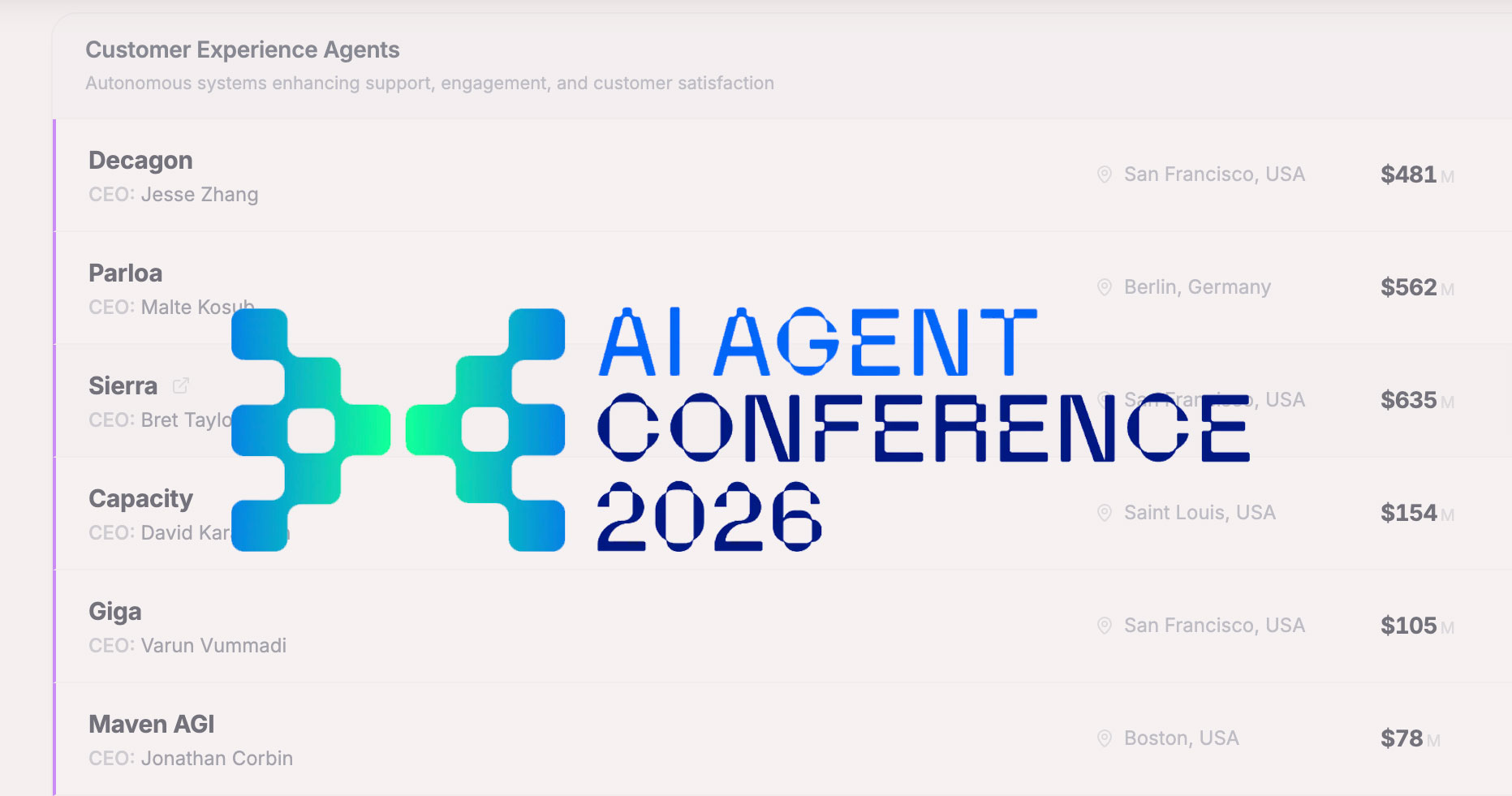
Alongside it, The Agentic List 2026 was unveiled: a curated ranking of 120 companies across three themes (Enterprises, Engineering, Industries), selected from over 5,000 nominations across nearly 2,000 screened companies, collectively backed by billions in funding.
Notable inclusions were:
Agentic Enterprises: Glean ($765M raised), Perplexity ($976M), Ramp ($2.8B), Apollo ($251M), Clay ($202M), Sierra ($635M), Decagon ($481M)
Agentic Engineering: Mistral AI ($3.2B), Cohere ($1.5B), n8n ($254M), Cognition ($596M), Augment Code ($252M), CrewAI ($18M), LangChain ($160M), Tavily ($25M, recently acquired by Nebius)
Agentic Industries: AlphaSense ($1.4B), Hippocratic AI (healthcare), Hebbia (legal), Harvey (legal)
The Numbers That Framed Sessions
The conference leaned hard on data, and speakers referenced these staggering figures throughout both days:
- $10.8–12 billion: Projected global agentic AI market size in 2026, growing at a 43.8–46% CAGR toward $139–196 billion by 2034 (Grand View Research, Precedence Research, Allied Market Research)
- $301 billion: Total global AI spending in 2026, with agentic AI representing 10–15% of enterprise IT budgets (IDC)
- 40%: Enterprise applications that will embed task-specific AI agents by year’s end — up from under 5% in 2024 (Gartner)
- 171%: Average ROI from enterprise agentic AI deployments globally; 192% for U.S. enterprises specifically (Deloitte 2026 State of AI in the Enterprise)
- 5.8x: Average ROI on AI investment within 14 months of production deployment (McKinsey)
- $4.6 million: Average annual savings per enterprise from AI-driven process automation across 3+ departments (McKinsey / IDC)
- 88%: Organizations now using AI in at least one function, up from 78% the prior year (McKinsey / Gartner)
- 100%: Of surveyed enterprises planning to expand agentic AI usage in 2026 (CrewAI survey of 500 C-level executives at $100M+ revenue organizations).”
- 6%: Organizations that qualify as true AI high performers with more than 5% of EBIT attributable to AI (McKinsey)
Day 1: Vision Meets Infrastructure
Opening keynotes set the tone with two back-to-back sessions spanning the full arc of the enterprise agent story.
Ameet Talwalkar, Chief Scientist at Datadog, kicked off the event, presenting how Datadog is rebuilding its observability platform to treat agents as first-class citizens alongside human users and traditional applications.
Arvind Jain, Founder and CEO of Glean — which surpassed $200 million in ARR at a $7.2 billion valuation after its $150 million Series F — took the stage alongside Sapphire Ventures’ Jai Das, defending that enterprise agents need a unified context layer connecting LLMs to internal business data, and saying that this approach has become the blueprint for how many large organizations when dealing with an agentic deployment.
“The real bottleneck is not the models themselves but connecting their reasoning power to the context inside your company,” he said.
Joe Moura, Co-Founder and CEO of CrewAI, said, “Enterprise adoption of agentic AI is accelerating faster than anyone anticipated. Organizations aren’t just experimenting — they’re building, shipping, and scaling agents into production.”
UiPath’s Raghu Malpani, Chief Product and Technology Officer, stated: “We’re at a pivotal moment where AI, deterministic automation, and orchestration are coming together to reshape how work gets done.”
Day 2: No Protocol War
During the Agentic Engineering track, a consensus emerged around two interoperability protocols that are rapidly becoming the backbone of enterprise agent infrastructure.
- MCP (Model Context Protocol), created by Anthropic in November 2024 and donated to the Linux Foundation’s Agentic AI Foundation, has become the standard interface connecting agents to external tools, databases, and APIs. By early 2026, MCP had crossed 97 million monthly SDK downloads, with adoption from every major AI provider, including OpenAI, Google, Microsoft, and Amazon. Its architecture is client-server via JSON-RPC 2.0.
- A2A (Agent2Agent Protocol), launched by Google in April 2025 and now governed by the same Linux Foundation body, handles the other half — how agents communicate with each other across organizational and platform boundaries. Google announced at Cloud Next 2026 that A2A has reached version 1.2 and is running in production at 150+ organizations, including Microsoft, AWS, Salesforce, SAP, and ServiceNow. Its architecture is peer-to-peer via HTTP and Server-Sent Events.
Multiple panelists emphasized that these are not competing standards. MCP handles vertical integration (agent-to-tool), while A2A handles horizontal coordination (agent-to-agent). The dominant question was how fast developers can implement both.
Google’s broader moves were discussed. The rebranding of Vertex AI to the Gemini Enterprise Agent Platform, the launch of Workspace Studio as a no-code agent builder, and the introduction of Agentic Data Cloud collectively represent Google’s bid to own the full stack from chip to inbox.
Salesforce’s Agentforce loomed over many conversations. It has reached $540 million in ARR with 18,500 enterprise customers. Speakers shared that Agentforce already autonomously resolves 70% of customer chats for clients like 1-800Accountant during peak seasons.
Dominant Theme of Security and Governance
CrewAI’s survey found that security and governance ranked as the #1 priority (34%) when enterprises evaluate agentic AI platforms. Ease of integration came second at 30%, and reliability came third at 24%.
Enterprises question whether agents can be deployed safely at scale without exposing unacceptable risk. Data backed this concern:
• 40%+ of agentic AI projects are at risk of cancellation by 2027 due to governance and ROI gaps (Gartner)
• 25% of enterprise breaches by 2028 will be traced to AI agent abuse (Gartner)
• 76% of enterprises cite data privacy and security as their top AI risk concern (IDC)
• 68% cite lack of identity security controls for AI specifically (IDC)
• Only 21% of organizations have a mature governance model for autonomous AI agents (Deloitte)
• 64% of CEOs acknowledge that FOMO drives AI investment before fully understanding the value (IBM)
• $2.1 billion in regulatory fines related to AI misuse were issued globally in 2025 — a 7x increase from 2023
CrowdStrike’s Atul Tulshibagwale and AgentCloak’s Peter Yared presented on agentic identity and the real attack surface of connecting agents to thousands of external MCP servers — including tool-poisoning attacks and data-exfiltration risks.
The concept of “Guardian Agents” — autonomous systems whose sole purpose is to monitor, oversee, and constrain the behavior of other agents — drew both enthusiasm and skepticism. Gartner projects 40% of CIOs will demand Guardian Agents by 2028.
Finance and Healthcare Lead Industry Deployments
• Steve Hasker, President & CEO, Thomson Reuters, demonstrated that many legacy information giants are betting their futures on autonomous workflows, not incremental copilot features.
• Rob Wisniewski, CTO of Credit & Insurance, Blackstone, discussed how agentic AI is moving beyond back-office automation into core deal-making and underwriting.
• Sirisha Kadamalakalva, MD, Global Head of AI/ML Investment Banking at Citi, covered agent deployment in regulated financial workflows.
• Karun Appapogu, Head of AI Technologies Architecture, Vanguard, and Kevin Hearn, SVP, Axos Bank, added retail and digital banking perspectives.
• Shipali Jangra, Director of Global Digital Product Management at American Express, spoke to operational scale.
Over 78% of financial services organizations have adopted AI agents.
• Commerzbank’s Microsoft-powered banking assistant resolves 75% of customer requests across 30,000+ monthly conversations.
• Allianz Partners is targeting 90% autonomous operations across claims and invoice processes spanning 1,000+ FTEs.
Healthcare showed equally compelling results.
• AtlantiCare‘s agentic AI clinical assistant achieved an 80% adoption rate among test providers, cut documentation time by 42%, and freed approximately 66 minutes per clinician per day.
• AI-powered imaging solutions are expected to prevent up to 2.5 million diagnostic errors annually. At the enterprise level, around 65% of healthcare organizations have adopted AI agents.
Commerce had its own dedicated sessions featuring Felipe Romano (PayPal), Robin Chiang (OpenTable), and Richard Cohene (Lightspeed Commerce).
In manufacturing, Samsung has committed to transforming all its facilities into AI-driven factories by 2030. Fujitsu’s AI development platform, launched in early 2026, reduces software modification time from three months to four hours, according to the company.
Seven Trends That Defined the Conference
1. Multi-Agent Orchestration Goes Mainstream
66.4% of the agentic AI market now focuses on coordinated multi-agent systems rather than single-agent solutions. LangGraph, CrewAI, and Google’s ADK are converging around graph-based and role-based orchestration models. Multi-agent systems are projected to grow at a 48.5% through 2030.
2. Context Engineering Replaces Prompt Engineering
Salesforce and others emphasized that agent performance depends less on how you ask a question and more on the information architecture surrounding the agent — which data sources it can see, how context is structured, and what gets retrieved when.
3. Agent Identity Becomes a Product Category
CrowdStrike, AgentCloak, Descope, C1, and others are building standalone products for authentication, authorization, and audit trails specifically for autonomous agents.
4. Headless AI and API-First Architectures
Salesforce’s Headless 360 and Google’s agent platform signal a shift from traditional UI-driven software to API-first architectures where agents access platforms programmatically rather than through dashboards. By 2028, one-third of user experiences will shift from native apps to agentic front ends.
5. The Agent Framework Landscape Consolidates
Framework adoption nearly doubled, rising from 9% to 18% of organizations (Datadog). LangGraph, CrewAI, and OpenAI’s Agents SDK are emerging as the dominant choices.
6. The Workforce Transformation Is Real
McKinsey estimates 44% of U.S. work could be performed by AI agents with current capabilities. 66% of enterprises are reducing entry-level hiring as they deploy AI. 77% of employers plan to upskill workers. AI/ML engineers’ salaries reached a median of $185K in the U.S., with demand up 74%.
7. The Governance Gap Is Existential
Over 40% of agentic AI projects risk cancellation by 2027. Only 21% of organizations have mature AI governance. $2.1B in AI-related regulatory fines were issued in 2025 alone. The EU AI Act is already forcing 42% of global enterprises to adjust practices.
What Enterprise Should Do
Several sessions converged on a practical playbook:
- Audit your current agent deployments — move beyond pilot metrics to production-grade KPIs, including completed tasks, escalation rates, and resolution speed
- Implement both MCP and A2A protocols to future-proof agent infrastructure for cross-vendor interoperability
- Establish an agent governance framework now — define identity, scope, audit trails, and escalation thresholds before scaling
- Prioritize context engineering over prompt engineering — invest in retrieval quality, data architecture, and information design
- Start where ROI is clearest: customer service, eCommerce, finance automation, and software engineering are the proven winners
- Budget for agentic AI security — tool poisoning, prompt injection, and data exfiltration are real attack surfaces
- Fix data foundations first — 52% of organizations cite data quality as their primary blocker, and IDC predicts a 15% productivity loss by 2027 for companies that fail to establish AI-ready data foundations
Discover more
IBL News is funded by the New York-based, family-owned company ibl.ai. Our stories adhere to the highest ethical standards in journalism and are available to news syndication agencies.