Pope Leo XIV Sparks a Global Conversation on How to Handle AI from a Moral Perspective
May 27, 2026
IBL News | New York
Pope Leo XIV’s document “Magnifica Humanitas,” or “Magnificent Humanity,” made public on Monday, has sparked a global conversation on how to handle AI from a moral perspective.
Pope Leo XIV has sparked a global conversation on how to handle AI from a moral perspective.
The Pontifex tried to inject Catholic moral values into a secular American industry that is transforming the world at lightning speed.
“Crucial questions impose themselves on our conscience and can no longer be avoided: Where are we going? Toward what goal do we wish to orient ourselves? What direction should we choose as a people and as a human community?” Leo wrote.
After being a major critic of immigration crackdowns and war, challenging, without intending to, the political leadership of his home country, Pope Leo XIV has added AI to that list, taking on Silicon Valley.
Leo, the first pope from the United States, called on Monday for A.I. to be “disarmed,” similar to the church’s support for nuclear disarmament, meaning “freed from logics that turn it into an instrument of domination, exclusion and death,” he explained in a speech at the Vatican.
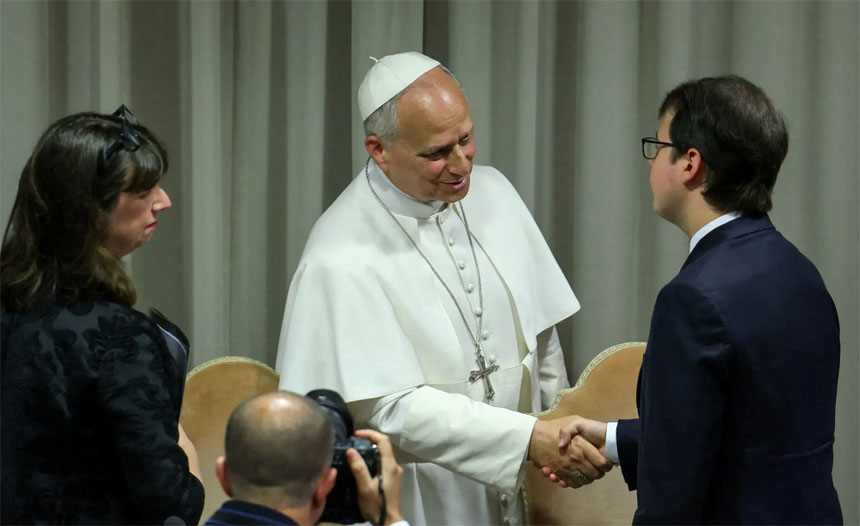
The launch event for the encyclical document was attended by high-powered AI pioneer Christopher Olah [in the picture above], a co-founder of Anthropic, which is pursuing a trillion-dollar valuation.
For the Pope, the way forward must involve collaboration, said Cardinal Blase Cupich of Chicago.
Leo opened his remarks with a special thank you to Mr. Olah, almost as if he were a head of state. “In turn, in the name of the church, I accept your invitation to walk together to listen and to speak and together to find the way for humanity in this time of artificial intelligence,” Leo said.
Church leaders under Pope Francis regularly held meetings called the “Minerva Dialogues” with technology leaders to discuss AI developments. Pope Francis met with the Group of 7 leaders in 2024 and urged regulation and called for a ban on lethal autonomous weapons.
Leo’s document, called an encyclical, is in many ways a culmination of that effort.
“At key moments in history, the Church is called to decipher the ‘new things’ in the light of the Gospel and the dignity of the human being,” Leo said. “Today we find ourselves facing a transformation of similar magnitude, with perhaps even greater consequences.”
Catholic universities in the U.S., including Georgetown and Santa Clara, have taken significant steps to advance the conversation about AI and Catholic moral values in academic and public circles.
The University of Notre Dame received a $50 million grant from the Lilly Endowment in December to develop faith-based ethical frameworks for AI through its Institute for Ethics and the Common Good.
Discover more
IBL News is funded by the New York-based, family-owned company ibl.ai. Our stories adhere to the highest ethical standards in journalism and are available to news syndication agencies.