"AI Needs to Be Disarmed to Prevent Domination, Exclusion, and Threats to Humanity," Warns Pope Leo XIV
May 26, 2026
IBL News | New York
In a stark warning and global alarm, Pope Leo XIV called for action during an explosive speech at the Vatican yesterday.
Marking a rare break from papal tradition, the Pontifex unveiled his first encyclical, Magnifica Humanitas, at the Vatican, warning that artificial intelligence “needs to be disarmed to prevent domination, exclusion, and threats to humanity.”
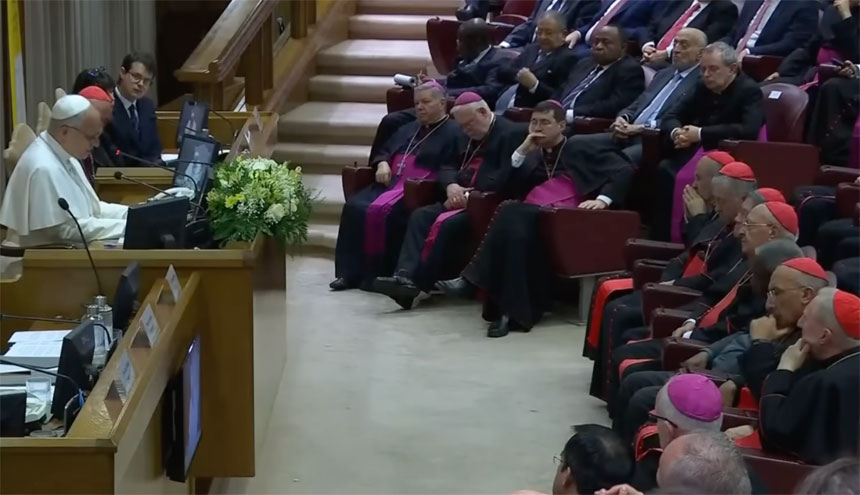
Speaking at the Aula Nuova del Sinodo, the pope urged global cooperation to ensure AI serves peace, justice, and the common good. The landmark address compared the AI revolution to the industrial transformations the Church faced over a century ago.
The encyclical Magnifica Humanitas (or “Magnificent Humanity”), on the protection of the human person in the age of artificial intelligence, was signed by the Holy Father on May 15, 2026, the 135th anniversary of Pope Leo XIII’s encyclical Rerum Novarum (known in English as “Rights and Duties of Capital and Labor.”)
Here are some of Leo’s themes in the encyclical:
• AI is fundamentally not human.
We must avoid the misconception of equating this type of “intelligence” with that of human beings. These systems merely imitate certain functions of human intelligence. In doing so, they often surpass human intelligence in speed and computational capacity, offering tangible benefits across many fields. Yet this power remains entirely tied to data processing. So-called artificial intelligences do not undergo experiences, do not possess a body, do not feel joy or pain, do not mature through relationships, and do not know from within what love, work, friendship, or responsibility mean.
Leo describes the field of artificial intelligence as swiftly evolving, and with real promise as a “valuable tool.” But he emphasizes throughout the text that, on a profound level, artificial intelligence is not human, however closely it approximates the human mind and even its soul.
This view clearly differentiates between machines and humans. It directly counters a view of some A.I. researchers and thinkers, including some in the room who have recently raised questions about whether A.I. systems may actually feel or express human emotion.
• Humane labor practices and just wages remain essential.
The various kinds of job insecurity, fragmented career paths, and automation must not be evaluated solely in terms of efficiency, but in relation to the dignity of the worker, the right to sufficient remuneration, and the genuine possibility of participating in society.
AI has already displaced many entry-level jobs, and while the full scope of its impact is far from clear, the mass automation of both white-collar and blue-collar work is likely to significantly reshape most sectors of the labor market.
Echoing many of his predecessors, including Pope John Paul II, Leo acknowledges that economic and technological systems may undergo radical upheavals over the course of history, but insists that the essential dignity of the worker — which includes fair wages — must remain at the center of any new order.
In another section, he condemns “new forms of slavery” connected to the digital economy, including the young people who work for minimal pay in jobs like data labeling and content moderation, and the even younger ones who labor under dangerous conditions extracting the rare earth materials the industry requires: “The bodies of these people are scarred, injured and worn down so that computational flow may continue uninterruptedly.”
• No technology can take away the dignity of ordinary human beings.
We are living through a rapid phase of transition, a “change of era,” in which — while some are vying for the future of new technologies and others dedicate themselves to reflecting on the matter — most people are watching and waiting, observing from afar and merely hoping for the best.
The Vatican invited people from Silicon Valley to the formal introduction of the encyclical on Monday, including, notably, Christopher Olah, a co-founder of Anthropic, who participated in the presentation.
But the encyclical itself reminds readers that the aspiring history-makers in the room are not the only ones who have worth. Most of the world’s population will simply have to live with the fallout of how those leaders steward this technological revolution. “Magnifica Humanitas” insists that each of those people “observing from afar” matters.
“The value of persons, however, does not depend on what they achieve or produce,” Leo writes elsewhere in the text. “There are rights that apply to everyone simply by virtue of being human.” The document uses the word “dignity” 100 times.
• Beware the temptation of erecting a new Tower of Babel.
With the heart of a shepherd and a father, I ask everyone to abandon the construction of yet another Tower of Babel and to join forces in building up the common good, so that humanity will never lose its beauty, and the world once again will come to recognize the human heart as the place where God desires to dwell.
The biblical story of the Tower of Babel recurs as a touchstone. The account appears in the Book of Genesis and describes a world in which a unified human population that speaks only one language decides to build a tower “whose top reaches to the heavens” to exert its own power and domination.
In response, God scatters the people across the earth, in what serves as an origin story for the existence of different languages and cultures.
Leo uses the Tower of Babel as an illustration of the pitfalls of pursuing uniformity and standardization, and the limits of ambitious undertakings that appear able to compete with the claims of religion. As many aspects of global culture homogenize, and technology becomes a kind of universal language, Leo’s call for humility and diversity stands in contrast. It’s also a reminder that many of the seemingly new ethical and social challenges posed by A.I. have ancient roots.
• The pope cites research and makes concrete recommendations.
In recent years, psychological and psychiatric literature has documented with growing insistence how early and unsupervised exposure to digital devices and social media can negatively impact sleep, attention span, control of emotions and relationships, especially during the most vulnerable stages of life, at times with tragic consequences.
For all its sweeping moral force, “Magnifica Humanitas” is also a practical document, showing how Leo is focused on pastoral care for the church’s hundreds of millions of families. It surveys research on the impact of technology on child development, including how early and unsupervised access to cellphones leaves children vulnerable to addiction, bullying, and sexual exploitation. Other topics include the regulation of data ownership and the use of A.I.-related weapons in war.
• Human life is beautiful.
For this reason, humanity — in all its grandeur and woundedness — must never be replaced or surpassed. We can embrace technological progress that alleviates suffering and unlocks new possibilities, provided we do not abandon the very essence of our humanity, namely, the capacity for relationship and love.
The title of “Magnifica Humanitas” says it all: In the end, Leo is less interested in technology than in humanity. Humans are flawed, vulnerable, and finite, the pope writes. We are increasingly inferior to the technology we have created if we measure only in cold terms of performance. But the pope writes with great affection for humans. The text ends with a wish “that we may bear witness to the grandeur of humanity, in which God has made his dwelling.”
Humanity, created by God in all its grandeur, is today facing a pivotal choice: either to construct a new Tower of Babel or to build the city in which God and humanity dwell together. In Jesus Christ, this humanity in its grandeur becomes the Way, the Truth and the Life, opening…
— Pope Leo XIV (@Pontifex) May 25, 2026
Discover more
IBL News is funded by the New York-based, family-owned company ibl.ai. Our stories adhere to the highest ethical standards in journalism and are available to news syndication agencies.