Microsoft announced in a press conference yesterday new AI-powered features on its Bing searches engine and Edge browser. The new version of Bing is available to try in a limited preview mode. Microsoft said it’s using conversational AI to create a new way to browse the web. The search engine is powered by ChatGPT and GPT-3.5, according to OpenAI CEO Sam Altman (as shown in the picture below). He took the stage momentarily during the presentation event, as shown on the video of the announcement, which was not live-streamed. This means that the new Bing can answer questions with lots of context, similar to the way ChatGPT does. It allows users to chat to Bing like ChatGPT, asking questions and receiving answers in natural language. The company said a waitlist will be available for the full version of Bing in the coming weeks. It also plans a mobile version of Bing. “It’s a new day in search,” said Microsoft CEO Satya Nadella. He argued that the paradigm for web search hasn’t changed in decades, but AI can deliver information more fluidly and quickly than traditional methods. “The race starts today, and we’re going to move and move fast,” Nadella said. “Most importantly, we want to have a lot of fun innovating again in search, because it’s high time.” The company showed various configurations. One of these displays traditional search results side-by-side with AI annotations, while another mode lets users talk directly to the Bing chatbot, asking it questions in a chat interface like ChatGPT. Unlike ChatGPT, the new Bing can also retrieve news about recent events. Microsoft says these features are all powered by an upgraded, more powerful version of GPT 3.5, which it calls the “Prometheus Model.” Later, Microsoft will bring its AI-powered chat features to all browsers, starting with Microsoft Edge. Edge browser will embed within its sidebar “chat” and “compose.” “Chat” will let users ask questions about the document or webpage they’re looking at, while “compose” acts as a writing assistant, helping to generate text, from emails to social media posts, based on a few starting prompts.
OpenAI, the creator of ChatGPT, released yesterday a free web tool, called AI Text Classifier, that detects if a text has been written by AI or not. This solution tries to address concerns, especially in higher education over plagiarism.  ChatGPT. New York schools, for example, have banned this technology on their networks. "The tool is a fine-tuned GPT model that predicts how likely it is that a piece of text was generated by AI from a variety of sources, such as ChatGPT," explained OpenAI. "This classifier is available as a tool to spark discussions on AI literacy." AI Text Classifier requires approximately 150 – 250 words (or a minimum of 1,000 characters) and it isn't always accurate. The text can even be edited easily to evade the classifier and is likely to get things wrong in text written by children. The user simply has to paste the text that he or she would like to check in this URL after logging in. The system will determine if the text was written by a machine, offering a five-point scale of results: Very unlikely to have been AI-generated, unlikely, unclear, possible, or likely. • OpenAI's View on Academic Dishonesty, Plagiarism Detection, and Education Breaking 🚨 OpenAI just launched an AI classifier that can accurately distinguish between AI-generated and human-written text 🤯 pic.twitter.com/jrE08ZQqYZ — Shubham Saboo (@Saboo_Shubham_) January 31, 2023
China's biggest search engine Baidu said yesterday it will launch a ChatGPT-like AI bot in March, according to sources quoted by Reuters and Bloomberg. It will be based on a large-scale machine-learning model developed by the company and trained over several years called Ernie. It will also allow users to get conversation-style search results, similar to OpenAI’s platform. Beijing-based Baidu sees ChatGPT-like apps as a potential way to leapfrog rivals, according to analysts. It seems that Baidu — China's Google — plans to launch the AI service as a standalone application and gradually merge it into its search engine, said a person to Reuters. The idea of Baidu seems to point out incorporating chatbot-generated results when users make search requests, instead of only links. Chatbots in China currently focus on social interaction, whereas ChatGPT performs better at more professional tasks, such as programming and essay writing. Baidu has been investing heavily in AI technology, including in cloud services, chips, and autonomous driving, as it looks to diversify its revenue sources. The news of Baidu’s plans sent shares up by 5.8%, the largest intraday gain in almost four weeks. “next six to 12 months will bring an explosion of experimentation, especially once companies are able to build on top of ChatGPT using OpenAI’s API. And the killer use case that emerges could be around generative AI’s impact on knowledge management. https://t.co/da2dyucwWr — Adam.GPT (@TheRealAdamG) January 30, 2023
Google researchers have created an AI system called MusicLM that can generate songs in any genre from any text. This AI was trained on a dataset of 280,000 hours of music to learn to generate coherent songs. TechCrunch reported the story first. However, Google, fearing the risks of copyright laws along with ethical challenges, said that it has no immediate plans to release it. The project was detailed in an academic paper. Creators gave MusicML instructions, such as "a calming violin melody backed by a distorted guitar riff", “create an enchanting jazz song with a memorable saxophone solo and a solo singer”, or “Berlin ’90s techno with a low bass and strong kick.” Researchers said that songs sound something like a human artist might compose, albeit not necessarily as inventive or musically cohesive. However, MusicLM managed to capture instrumental riffs, melodies, and moods. Google researchers showed that the system could create melodic stories fit for a movie soundtrack or generate audio played by a specific type of instrument in a certain genre. This AI “musician” can be set to compose music inspired by places, epochs or requirements (e.g. motivational music for workouts). A concern of Google is the tendency of MusicML to incorporate copyrighted material from training data into the generated songs. During an experiment, they found that about 1% of the music the system generated was directly replicated from the songs on which it trained. Deepfake music stands on murky legal ground. Music Publishers Association argued that AI music generators violate music copyright. Legal copyright experts say that an AI system music would be considered a derivative work, in which case only the original elements would be protected by copyright. Several lawsuits likely would be filed pertaining to the rights of artists whose work is used to train AI systems without their knowledge or consent. Before MusicML, there have been other attempts at generative music, such as Riffusion, Dance Diffusion, Google’s own AudioML, and OpenAI’s Jukebox.
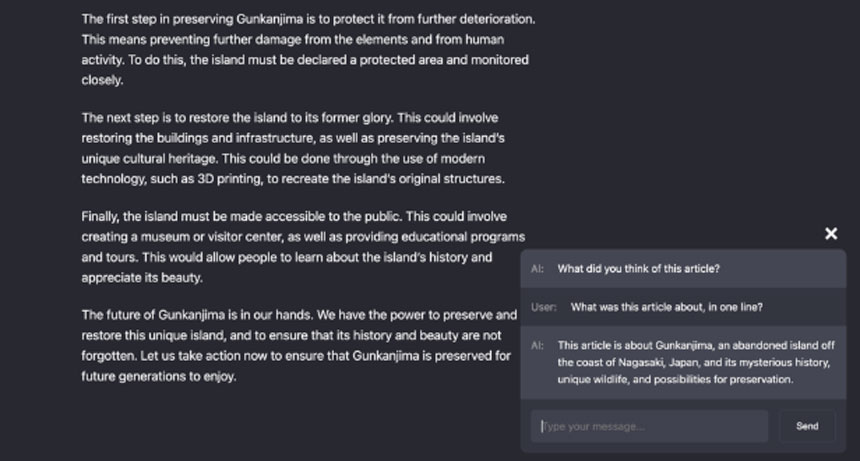
Businesses around large language models (LLMs) and ChatGPT continue popping up. One of the latest is Usemeru.com, which allows people to ask questions about Documents, HTML Files, and JSON files in natural language. Large volumes of text can include recruiting call transcripts, request tickets from customers, and medical records. Users upload and index those documents and files and ask questions about the document. The app parses input and delivers natural language responses. Essentially, when a client submits a document to Usermeru's API, the system indexes the document and stores the index on the company servers. Clients can then query the index via an LLM, such as GPT-3, and obtain a response. This approach is more robust than passing the document as a part of the prompt. In addition, because the user is querying the index, he/she doesn't waste tokens as prompts, and can therefore build much larger and more complex queries. Documents larger than 4096 tokens can also be queried effectively. Usermeru.com also allows you to embed Stable Diffusion image generation into your applications with low latency, variable sizing, and automatic resolution upscaling. The application is available as an API for dense data retrieval at a starting price of $2.75 per concept. People in finance/investing, law, humanities/social science research might find this useful in order to search for documents.