

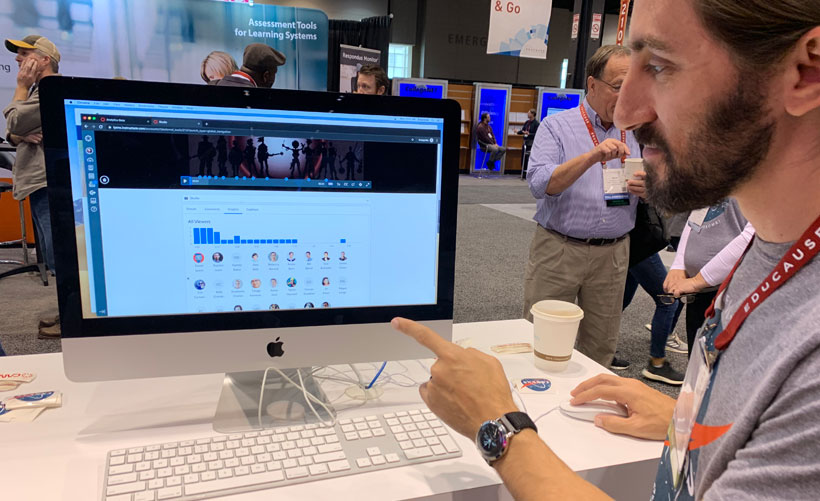
The University of California San Diego announced yesterday the release of the Open edX Caliper Feed feature, a data solution that allows for the real-time collection of course activity to flow into an analytics tool. The complete code is available for free at: https://pypi.org/project/openedx-caliper-tracking. Caliper is a standard format for capturing and presenting measures of learning activity. Access to real-time reporting helps instructors and course designers more effectively design classes and boost student success. For example, some students react better to auditory content, while others prefer visual or video-driven methods. Karen Flammer, Director of the Center for Digital Learning, at UC San Diego, said, "It’s a tremendous development; it’s not easy to see what parts of a course students are spending time on, what they are concentrating on and where they are struggling. From a practical standpoint, we’ll be able to use this data to assess and improve learning pathways. Obtaining access to this data supports delivering customized resources and activities tailored to the unique needs of each learner.” • UC San Diego News Center: UC San Diego Updates edX Platform to Improve Online Learning Experience
Now that online degrees are widely accepted by employers in the U.S., there is a new demand for the Master’s program business and universities are considering the OPMs (Online Program Managers) outsourcing solution. OPM for-profit companies are mostly providing financial, enrollment, marketing, and curriculum design services. In a way, they are both banks and student recruitment/retention machines. 2U is the leading publicly traded company, with a market value of over $4.5 billion. Universities that partnered with an OPM have outperformed their peers in increasing online enrollment, a recent study by Eduventures found. The problem lies in the fact that institutions do not want to give up academic control and don't like the way OPMs make money –by attracting students and keeping them enrolled, many times with aggressive techniques. They tend to forget that OPMs need a certain enrollment threshold –typically 2,000 students, according to two experts– to recoup their investment or turn a profit. Non-profit colleges seem to be living under the assumption that corporations follow an altruistic idea of higher education. They are not, despite their fancy mission statements. Many academic administrators and faculty members would be scandalized listening to some of the conversations happening on OPM's enrollment call-centers, as IBL News checked. They would immediately break their contracts and refuse to hire these companies again. These practices are one of the best-kept secrets in the industry. To be honest, OPMs also offer a proven track record when is about designing high-quality programs. Moreover, by overcoming universities’ enrollment stagnation challenge, OPMs are keeping institutions flourishing. We can romanticize the higher education landscape as much as we wish, but in the end, it is a business, a genuinely American business. And OPMs, despite some of their practices, are fit partners for universities in the common goal of generating revenues in the new digital economy while educating.
Asked about how edX plans in the field, Mr. Haseltine explained that AI and Machine Learning will be used to customize learning experiences, taking into account a "learner's prerequisite knowledge, gaps in skills and competencies, learning delivery preferences, and desired curriculum and career pathways." "We are staying ahead of this trend by collaborating closely within our ecosystem to bring a steady stream of innovations to our courses and programs." (…) "We are fortunate to have a large, engaged, worldwide community who are committed to advancing mass personalization," said.
Additionally, this organization is launching new instructor-led and self-paced online courses simultaneously to the upcoming GPU Technology Conference (March 17-21, San Jose). Through its learning ecosystem, DLI will launch on March 17 two online, self-paced courses on Accelerating Data Science Workflows with RAPIDS and Data Science Workflows for Deep Learning in Medical Applications. These courses will also be offered as instructor-led sessions at the GTC Conference with a certificate of competency. They will be part of a training program comprising of over 75 instructor-led training sessions, six full-day workshops, and self-paced training sessions with GPU-accelerated workstations running in the Microsoft Azure cloud. NVIDIA's DLI learning ecosystem is powered by IBL Education and partially uses Open edX technology.
This unlimited enrollment, which will increase to $269 after May 11, includes access to all short courses which offer a Certificate of Achievement. Courses not included are premium, program assessments, degrees (although open taster courses are), and classes which offer a Statement of Participation. Certificates of Achievement will be kept indefinitely regardless of whether the user renews the yearly subscription. With this recurring revenue strategy, FutureLearn introduces a new pricing model, Pluralsight style, and moves ahead of Coursera, edX, and Udacity. From the learner perspective, it is a drastic price reduction because for the same price as four-course upgrades, they are able to access a catalog of around 1,000 courses. FutureLearn announcement Class-Central analysis