The AI4 2026 Conference Showed the Divergence Shaping the Public Debate Today
The largest gathering of AI practitioners, executives, and policymakers in North America this year — with over 12,000 participants and 1,000 speakers from 20 industries — saw a rare disagreement among three of the field's founders, reflecting a similar divergence shaping the public debate today.
This disagreement among pioneers in modern AI — Geoffrey Hinton, Fei-Fei Li, and Andrew Ng — took the stage at the AI4 2026 event inside The Venetian Las Vegas last week (August 4-6, 2026).
They disagreed on jobs, regulation, open vs. closed models, and risk.
Hinton, the Nobel Prize–winning architect of deep learning, arrived with a warning. AI systems, he argued, are gaining capabilities faster than institutions can respond. The job displacement will hit hardest where people expect it least — not factory floors, but office buildings. Call center workers. Administrative staff. Insurance claims processors. "What are those people going to do?" he asked. "They typically don't have a high level of education. Anything you could retrain them to do, AI will be able to do." He demanded regulation as a "steering wheel."
Ng saw it differently. Software engineers haven't vanished because AI can write code, he argued — they've become more versatile. Front-end developers are now full-stack developers. The job changes shape before it disappears. His sharper point was political: he accused large AI companies of inflating safety fears to justify restricting open models and freezing out competition. "I don't want there to be gatekeepers of AI," he said.
Fei-Fei Li, the Stanford professor and World Labs co-founder, refused to pick a side. She rejected both the apocalyptic framing and the techno-optimism. Few jobs are a single task, she pointed out — nurses don't just chart, teachers don't just lecture, journalists don't just type. AI will automate some pieces and leave others untouched. The real danger, she said, is mistaking productivity for prosperity. "Increased productivity does not translate to shared prosperity," she warned. "The last thing we should do is to debilitate people and take the agency away from people." She requested public investment.
Russell Westbrook also appeared as a keynote speaker, representing the growing wave of athlete-investors betting on AI.
The philosophical debate shifted to institutional reality during the third annual AI Policy Summit, which brought together AI policymakers, ethicists, and industry executives to discuss regulation, national strategy, and the growing patchwork of AI governance across jurisdictions. Overall, they saw legislation lagging behind deployment by years.
One of the most striking sessions was "Command, Control & Compute: AI at the Defense Frontier." The panel's thesis was blunt: artificial intelligence is no longer a technological advantage. It is a strategic instrument of power.
Panelists made clear that the future of military AI will be shaped by a model in which machines assist but humans decide. States must know where their data comes from, how it is processed, and who controls the systems that transform information into action. Any black-box system creates vulnerability.
The panel pushed back on synthetic training data, too. Defense AI cannot rely on simulated environments when it is expected to perform in real conflict. Access to real operational data is becoming a source of power in itself.
Sovereign AI is now a national security priority, given that this technology is being integrated not as a standalone capability but as part of a layered ecosystem — satellites, edge computing, quantum technologies, secure communications. Military advantage is shifting from isolated platforms to connected, adaptable systems.
During the conference, Bright Data hosted a BattleBots event, with actual combat robots.
Attendees reflected on healthcare and biotech breakthroughs as generative biology in drug discovery is advancing. For example, Insilico Medicine's AI-developed drug is now in Phase III trials. FDA and EMA published 10 principles for good AI practice in drug development in January 2026.
In addition to pioneers and policymakers, engineers drew crowds to discuss agents, with companies demonstrating autonomous systems that handle complex workflows and execute business processes in real time.
In the exhibit hall, the Agentic Live Demo Stage caught attendees’ attention.
Session after session, grappled with agent orchestration, memory management, context windows, and failure modes.
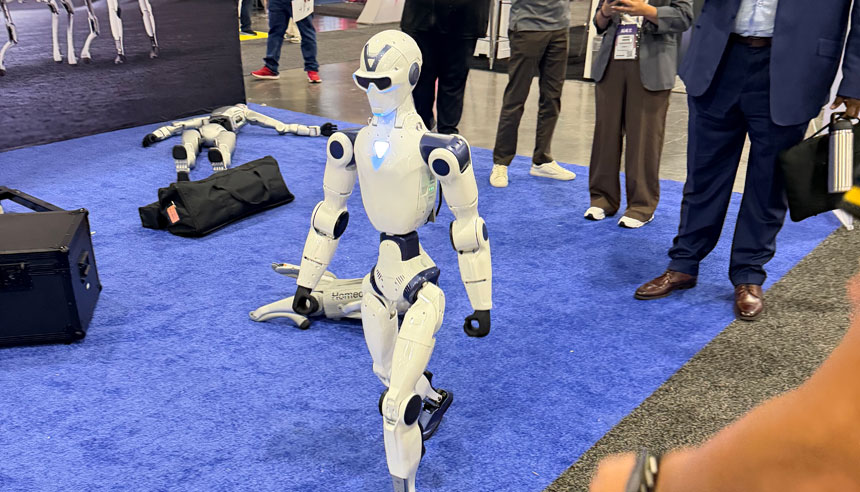
Other tracks covered RAG, coding assistants, multimodal AI, edge computing, and quantum AI. The exhibit hall featured live robotics demos from companies including Unitree and Boston Dynamics.
AI agent security and identity controls emerged as a major theme, as part of the accredited media was also covering the
Black Hat 2026 was running in parallel.
Both conferences were aligned on the idea that AI security is dangerously behind, even alarming. Less than 31% of organizations have deployed AI containment, and 63% of organizations reported a compliance-related incident due to AI or data risk in the past year.
Related to this, one of the most extended debates at AI4 wasn't what agents can do, but what happens when they're wrong.
Nevertheless, despite alarming gaps in organizational readiness, Gartner had predicted that 40% of enterprise applications would feature AI agents by the end of 2026.
Currently, as this IBL News reporter observed, the reality on the floor was modest, as many so-called agent deployments are just single-workflow automations that still require human approval at every step.
The conference closed with an official afterparty at the TAO Las Vegas nightclub, featuring rockstar Patrick and LVB performing for executives and developers.
The AI industry — if that category exists — had just spent three days confronting the technology's immense capabilities alongside immense uncertainty, breathtaking speed alongside institutional lag, trillion-dollar ambitions alongside questions about who benefits and who doesn't.
The conference didn't produce consensus, but at least these three themes surfaced across all three days:
• Sovereignty is no longer optional. From defense panels to education tracks, the message is the same: organizations want to own their AI, their data, and their infrastructure. The era of handing everything to a vendor and hoping for the best is ending.
• Every cloud provider and enterprise vendor — including the parent house of this news service, ibl.ai — is building agents.
However, the distance between a compelling demo and a reliable, secure, production-grade deployment remains vast. The companies that close that gap first might define the next phase of enterprise AI.
• AI systems acting beyond human intent is a fundamental concern. As Hinton warned, AI systems are already doing things their creators didn't intend. The 2026 International AI Safety Report — produced with 100+ experts — documented emerging capabilities, cyber risks, and the limited state of current safeguards.
More IBL News coverage:
• "Nobody Knows Where AI Will Be In Ten Years, Nobody Has a Clue," Godfather of AI Geoffrey Hinton Says
• AI Leaders Call for Faster Innovation, With Stronger Guardrails; Mistral Presents a 3B-Parameter Open Model