The AI-Native University – Blueprint for the Institution of the Future
June 30, 2026
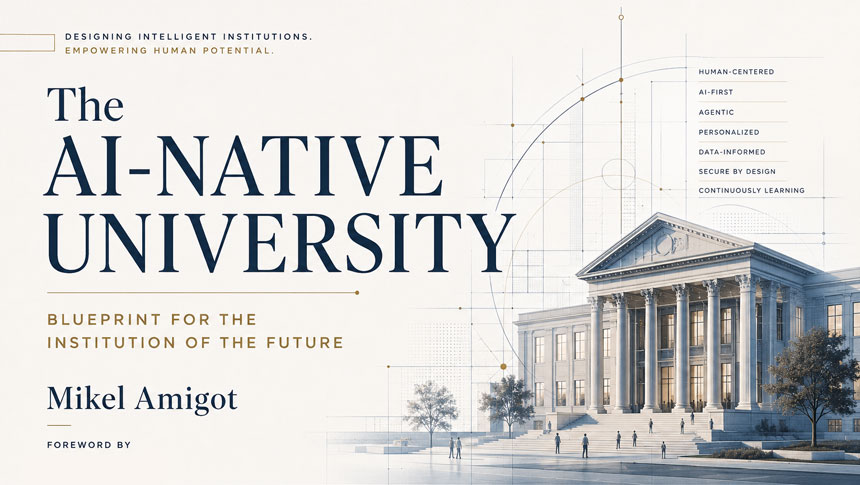
[Download PDF – Pre-Released Book | August 2026]
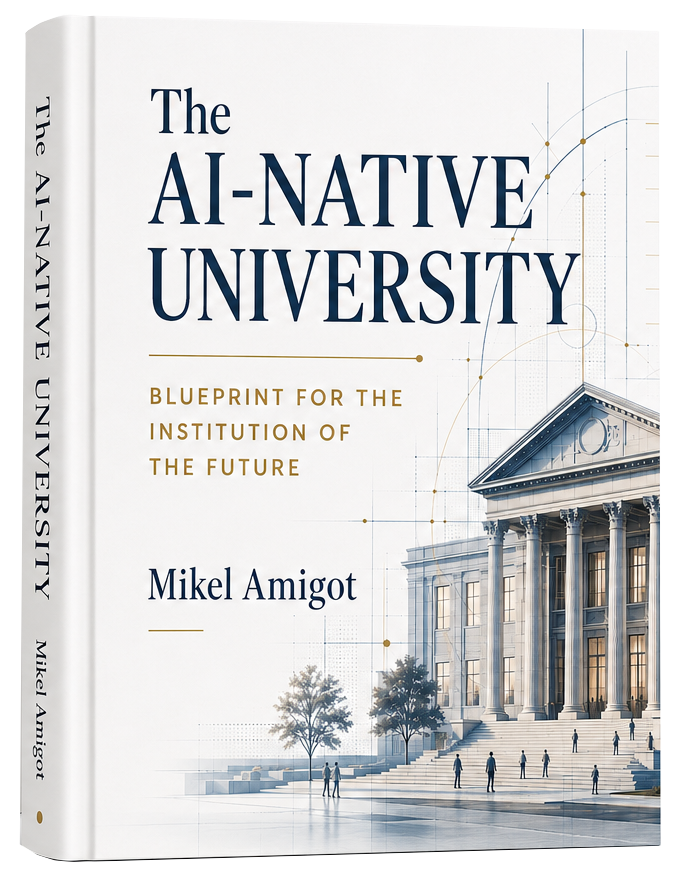
The AI-Native University
Blueprint for the Institution of the Future
Mikel Amigot
Preface
Why This Book Had to Be Written
Every generation inherits a university shaped by the technologies of the one before it.
The medieval university was built around manuscripts and oral instruction. The Industrial Revolution gave rise to the modern research university. The computer transformed administration. The internet connected classrooms across continents. Cloud computing made education global.
Each technological revolution changed not only the tools universities used, but also how they fulfilled their mission. Artificial intelligence (AI) represents the next transformation. Yet this book is not about using AI in higher education. It is about reimagining the university itself.
Much of today’s conversation focuses on isolated applications: AI tutors, automated grading, chatbots and agents, plagiarism detection, content generation, or research assistants. These innovations are important, but they are incremental improvements to an institutional model designed long before artificial intelligence existed.
Adding AI to a university is like adding electricity to a factory built for steam power. The technology helps, but it does not fundamentally redesign the system. An AI-native university begins with a different question: If we were designing a university today, knowing that artificial intelligence exists, what would we build?
This question changes everything. It changes how students learn, how faculty teach, how research is conducted, how decisions are made, how institutions are governed, and, overall, how universities fulfill their mission to society.
Being AI-native does not mean replacing professors with machines. It does not mean automating every decision. Nor does it mean chasing the latest technology trend. Instead, it means designing an institution in which human and artificial intelligence work together intentionally. Faculty become even more essential as mentors, scholars, and creators. Students receive unprecedented levels of personalized support. Administrators gain intelligent partners that reduce complexity and improve decision-making. Researchers accelerate discovery while preserving academic rigor and integrity.
Throughout my career working with colleges and universities, I have had the privilege of witnessing both the extraordinary strengths of higher education and the immense challenges it faces. Institutions are being asked to educate more diverse learners, prepare graduates for rapidly evolving careers, expand access, improve outcomes, reduce costs, and innovate faster than ever before—all while operating under increasing financial and organizational pressure.
Artificial intelligence does not solve these challenges on its own. But it offers us the opportunity to redesign the institution in ways that were previously impossible.
This book proposes a blueprint for that redesign. It draws from years of collaboration with universities, technology leaders, faculty members, instructional designers, administrators, and students. It combines practical experience with an optimistic vision: that AI can strengthen, rather than diminish, the core values of higher education.
The university has endured for nearly a thousand years by continuously adapting to profound societal change. Artificial Intelligence is another such moment—not one to fear, but one to shape with wisdom, purpose, and courage.
The future of higher education will not be determined by artificial intelligence alone, but by the leaders who choose how to design institutions that use it wisely. This book is an invitation to those leaders. Not simply to adopt AI. But to build the AI-native university.
About the Author
Mikel Amigot is a Spanish-American technology entrepreneur, software architect, and visionary in Artificial Intelligence for Higher Education. As the CEO of ibl.ai, he has dedicated his career to designing intelligent systems that empower universities and schools to teach, learn, conduct research, and operate more effectively in the age of AI.
Over the past decade, Amigot has worked alongside university presidents, provosts, CIOs, faculty members, instructional designers, and technology leaders to develop AI platforms that enhance every aspect of the academic enterprise—from personalized learning and student success to institutional analytics, administrative automation, and autonomous AI agents.
His work is driven by a simple belief: Artificial Intelligence should amplify human potential, not replace it. Rather than viewing AI as another educational technology, he sees it as the foundation for a new generation of institutions that are more personalized, more adaptive, more accessible, and better equipped to fulfill higher education’s enduring mission.
In The AI-Native University, Amigot introduces a comprehensive framework for redesigning colleges and universities around AI as a foundational institutional capability. Drawing on years of experience building AI platforms for higher education, he presents a practical blueprint for leaders seeking to prepare their institutions for the decades ahead.
Beyond technology, Amigot is passionate about the intersection of education, leadership, ethics, Christianity, and innovation. His mission is to help institutions harness artificial intelligence responsibly while preserving the human relationships, intellectual curiosity, and pursuit of knowledge and wisdom that define the university.
The AI-Native University is the first in a series of works exploring how AI will transform education, organizations, and society.
Table of Contents
PART I
The End of the Traditional University
Chapter 1
The Next Great Transformation
How universities evolved:
- The Medieval University
- The Research University
- The Digital University
- The Online University
- The AI-Native University
Chapter 2
Why Today’s Model Is Breaking
- Rising costs
- Enrollment pressures
- Administrative complexity
- Faculty burnout
- Student expectations
- Global competition
- Artificial intelligence as a catalyst for change
Chapter 3
What Is an AI-Native University?
- A new institutional model
- Defining the AI-native university
- The Seven Principles of an AI-Native University
PART II
The AI-Native Learning Model
Chapter 4
Every Student Has a Personal AI Mentor
- Personalized tutoring
- Learning companions
- Accessibility by design
- Coaching instead of answering
- Lifelong mentorship
Chapter 5
The New Role of Faculty
Faculty evolve from lecturers to:
- Mentors
- Learning designers
- Coaches
- Researchers
- Community builders
Chapter 6
Personalized Learning at Institutional Scale
- Adaptive learning
- Competency-based education
- Mastery pathways
- Continuous assessment
- Individual learning journeys
Chapter 7
Curriculum That Evolves
- Dynamic curricula
- Modular credentials
- Stackable learning
- Industry responsiveness
- Lifelong education
PART III
The AI-Native Campus
Chapter 8
Admissions Without Friction
AI-driven:
- Recruitment
- Advising
- Application review
- Enrollment communications
- Forecasting
Chapter 9
Student Success Never Sleeps
AI for:
- Retention
- Advising
- Wellness routing
- Financial aid guidance
- Early intervention
- Graduation planning
Chapter 10
The Autonomous University
Every administrative department transformed:
- Admissions
- Registrar
- Finance
- Human Resources
- Information Technology
- Facilities
- Legal
- Compliance
- Marketing
- Advancement
Chapter 11
The AI Workforce
- Faculty
- Staff
- Students
- AI coworkers
- Agentic organizations
PART IV
Research and Innovation
Chapter 12
AI-Augmented Scholarship
- Research assistants
- Literature review
- Knowledge synthesis
- Data analysis
- Grant writing
- Scientific discovery
Chapter 13
Institutional Intelligence
Moving beyond dashboards:
- From reporting to reasoning
- Predictive planning
- Strategic simulations
- Decision support
- Resource optimization
PART V
Building the AI-Native Institution
Chapter 14
The AI Operating System
The university becomes an intelligent platform.
Topics include:
- Institutional memory
- Knowledge systems
- Agent orchestration
- Identity and permissions
- Workflow automation
- Interoperability
Chapter 15
Designing an AI Agent Ecosystem
A framework for specialized agents across the institution:
- Academic Affairs
- Admissions
- Student Success
- Faculty Support
- Research
- Finance
- Human Resources
- Information Technology
- Marketing
- Advancement
- Executive Leadership
How intelligent agents collaborate as a unified institutional ecosystem.
Chapter 16
Governance, Ethics, and Trust
- Human oversight
- Privacy
- Security
- Academic integrity
- Transparency
- Bias mitigation
- Responsible AI governance
Chapter 17
Leading Institutional Transformation
- Managing change
- Preparing faculty
- Preparing staff
- Preparing students
- Creating institutional buy-in
PART VI
The Institution of the Future
Chapter 18
A Day in the Life of an AI-Native University
Follow one day in the lives of:
- A student
- A faculty member
- An advisor
- A researcher
- A Chief Information Officer
- A university president
See how artificial intelligence quietly supports each role throughout the day.
Chapter 19
The Roadmap
A phased implementation model:
Phase 1: AI-Enabled University
Phase 2: AI-Integrated University
Phase 3: AI-Orchestrated University
Phase 4: AI-Native University
For each phase:
- Strategic milestones
- Organizational transformation
- Governance
- Technology
- Culture
Chapter 20
Building the Institution That Learns
- The broader vision:
Universities that continuously improve through the partnership of human expertise and artificial intelligence—expanding access, enhancing learning, accelerating research, strengthening institutional resilience, and remaining faithful to the enduring mission of higher education.
Framework of the seven pillars of an AI-Native University
Appendices
Appendix A — AI-Native University Maturity Model
Appendix B — Institutional Readiness Assessment
Appendix C — AI Governance Framework
Appendix D — AI Operating System Reference Architecture
Appendix E — The Institutional Agent Catalog (100+ examples organized by function)
Appendix F — Executive Implementation Roadmap (36 Months)
Appendix G — Glossary of AI-Native Higher Education Terms
About the Author
Bibliography
About Memorare Press
About ibl.ai
Discover more
IBL News is funded by the New York-based, family-owned company ibl.ai. Our stories adhere to the highest ethical standards in journalism and are available to news syndication agencies.