Owned AI Infrastructure and Data Sovereignty Emerge as Dominant Themes Across Industries
May 1, 2026
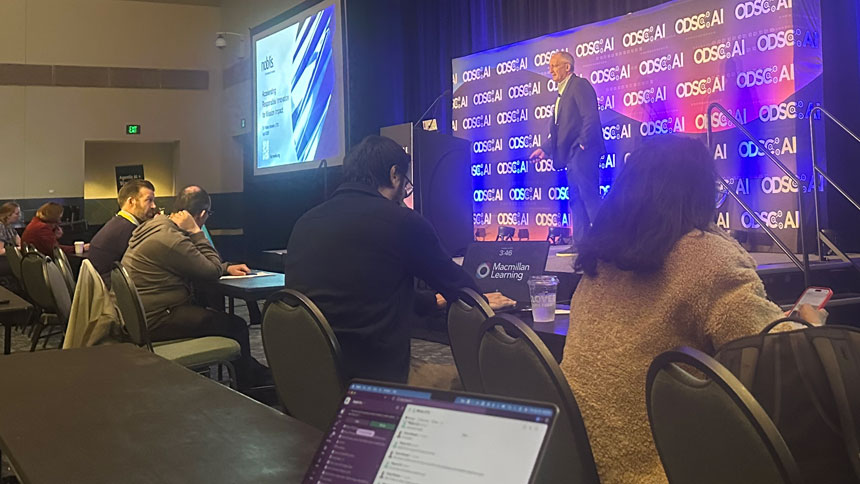
IBL News, Boston
“Data quality, not model size, is the primary bottleneck in AI performance,” said Datology’s CEO, Ari Morcos, at the ODSC AI East 2026 in Boston this week. “Better training data and smaller models outperform larger ones trained on slop,” he explained.
Ami Bhatt, FDA Chief Innovation Officer and Chair of the American College of Cardiology, discussed AI in clinical decision support and the FDA’s evolving framework for validating AI systems in healthcare. “At the FDA, we are building regulatory infrastructure for AI — not blocking it, but demanding rigor.”
Across healthcare, finance, government, legal, education, manufacturing, and energy, a pattern emerged: the organizations moving fastest on AI are the ones that have solved the data privacy and deployment ownership equation, performing at frontier quality while keeping patient data locked down. They’re not asking “which model” but “where does it run, who owns the data, and can we audit every decision?”
By industry sector, the ODSC East 2026 generated several outcomes:
In Healthcare and Biopharma, AI in drug discovery dominated. Generative AI for molecular design is now producing novel candidate compounds in hours instead of months. Multiple sessions covered AI-driven biomarker discovery — using foundation models to identify disease signatures in genomic data that traditional bioinformatics pipelines miss entirely.
At major health systems, medical imaging AI has evolved into predictive modeling for clinical outcomes.
Healthcare sessions circled back to the issue of data privacy, as foundation models require massive datasets to perform, but HIPAA, patient consent, and institutional data governance impose hard constraints on data sharing. Synthetic data generation and federated learning emerged as the most discussed workarounds, but neither is mature enough for enterprise-scale deployment yet.
In Government and Defense, federal agencies are moving from “should we use AI?” to “how do we deploy AI in air-gapped, classified, and compliance-heavy environments?” FedRAMP, NIST 800-53, and ITAR requirements dominated the conversation.
The agencies that are moving fastest — DOD, intelligence community, DHS — are the ones with the most acute operational pain points and the budget to solve them.
Google’s signing a classified AI deal with the Pentagon (reported during the conference week) added urgency to the discussion. The open question was whether the government AI infrastructure should be owned by hyperscalers or if agencies would build sovereign capability.
An important takeaway was that only American-made models and compliance-first would have a massive moat.
In Financial Services, a recurring theme was zero tolerance for AI hallucinations, as they could be a compliance violation. Multiple sessions addressed guardrails, output validation, and human-in-the-loop architectures specifically designed for regulated environments.
Another takeaway is that the shift to open source in finance was real, and self-hosted, private deployment is becoming the default architecture. Several financial services practitioners described their institutions moving from proprietary APIs (OpenAI, Anthropic) to self-hosted open-weight models (Llama, DeepSeek, Mistral), driven not by cost but by data sovereignty.
When your trading strategies, M&A documents, and client portfolios are the data, sending them to a third-party API is a non-starter.
Financial services want frontier-quality AI but absolutely cannot accept the data exposure inherent in shared platforms.
In Manufacturing and Supply Chain, AI for robotics reflected the convergence of foundation models with physical systems. Sessions covered reinforcement learning for warehouse automation, computer vision for quality inspection, and multi-agent coordination for logistics.
The manufacturing story is about integration, not intelligence. The models are capable enough — the bottleneck is connecting AI to legacy ERP systems, SCADA networks, and supply chain databases that were built decades before APIs existed. Several sessions addressed the “last mile” problem of getting AI outputs into SAP, Oracle, and custom MES systems.
Participants agreed that manufacturing AI is a data integration challenge first and a model challenge second. The organizations winning here are the ones who’ve invested in data infrastructure, not just model training.
In Legal and Compliance, the recurring pattern was that law firms and in-house legal teams were deploying LLMs for document review, contract analysis, and legal research, but with extreme caution.
Attorney-client privilege is the hard constraint. Unlike other industries where data privacy is a regulatory concern, in legal it’s a constitutional one. Multiple speakers from regulated industries described building air-gapped AI systems specifically so privileged communications never touch external infrastructure. The phrase “private deployment” came up more in legal-adjacent sessions than anywhere else.
AI governance frameworks — as Shoshana Rosenberg presented — are being adopted fastest by legal departments, not IT departments. Lawyers understand regulatory risk intuitively and are building the policies and controls that other functions are still debating.
Regarding Energy, Utilities, and Infrastructure companies, practitioners highlighted the need for AI that can be deployed reliably and deterministically on local hardware, without cloud dependencies, given that operations often occur on factory floors, in substations, and on drilling platforms, where connectivity is unreliable or prohibited.
In terms of Software Engineering and Devtools, developers at the conference analyzed how to evaluate whether AI-written code is correct, secure, and maintainable. Evaluation systems, test generation, and multi-agent code review (in which multiple AI agents check each other’s work) were the most-discussed engineering patterns.
Karen Zhou from Anthropic’s Claude Code team and Robert Brennan from All Hands AI (OpenHands/OpenDevin) enlightened the discussion.
Software developers mostly agreed that competitive edge was in AI systems that can reason across codebases, call external services, and operate production infrastructure — not just autocomplete.
Finally, in Higher Education and Research, Brown University’s Michael Littman, Boston University’s Mohammad Soltanieh-ha, Bentley University’s Noah Giansiracusa, and MIT’s Max Tegmark delivered major sessions. The academic-to-production pipeline has never been shorter.
Many institutions are now building their own AI operating systems — course-specific agents, research assistants, administrative automation tools, and student support chatbots. Multiple sessions referenced institutions deploying self-hosted LLMs on their own cloud infrastructure to maintain FERPA compliance and student data privacy.
One takeaway was that institutions that own their AI infrastructure, rather than subscribing to shared platforms, would emerge as the leaders.
Discover more
IBL News is funded by the New York-based, family-owned company ibl.ai. Our stories adhere to the highest ethical standards in journalism and are available to news syndication agencies.