Practitioners at the ODSC Event Examined Why AI Enterprise Projects Failed and Analyzed Tectonic Shifts
April 30, 2026
Mikel Amigot, IBL News | Boston
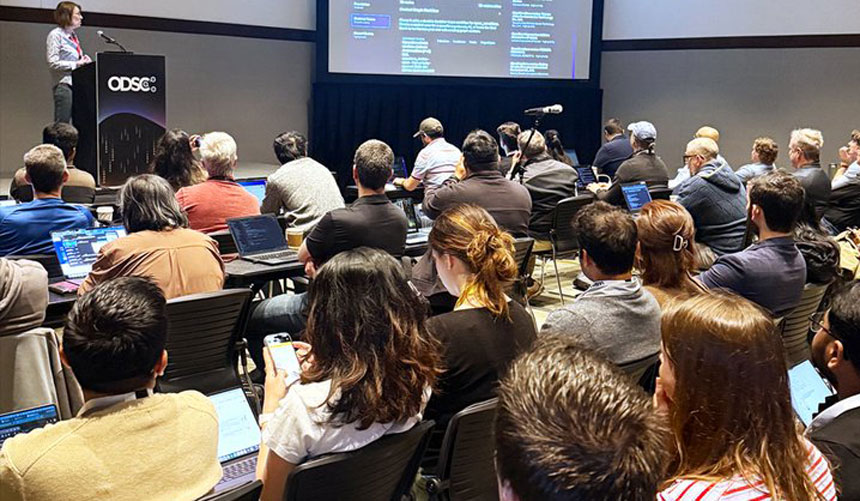
Around 3,500 AI practitioners (mostly data scientists, engineers, researchers, and business leaders) are attending the 11th ODSC (Open Data Science Conference) East conference this week in Boston, with a dominant theme: it’s time to execute Agentic AI across industries.
With 300+ hours of expert-led content, 250+ speakers, and 15+ dedicated tracks, participants shared insights on the race to build the infrastructure that will define who controls AI in production.
The conference has surfaced three tectonic shifts:
1. Agents are replacing chatbots — not as a trend, but as a deployment pattern. Organizations that are still building Q&A bots are already behind.
2. Governance is infrastructure, not paperwork — the organizations that build technical governance (audit trails, verification, guardrails) will move faster than those that skip it.
3. The model is commoditizing; the stack is the moat — with 8 frontier models shipping in a single week and open-source catching up to proprietary, the competitive advantage has shifted from “which model” to “what infrastructure do you own.”
ODSC dedicated an entire track to Agentic AI & Workflow Automation for the first time. Gartner’s prediction — 40% of enterprise apps will embed AI agents by the end of 2026 (up from 5% today) — was quoted in several keynotes.
• MIT’s Max Tegmark challenged the room to move beyond “vibe coding” toward provably correct AI systems.
• Pedro Domingos introduced “tensor logic” as a unifying language for AI.
• Nouha Dziri (Cohere Labs) argued that hallucination mitigation requires architectural changes, not just better prompting.
• Olivia Buzek from IBM ran a pre-conference workshop on building responsible AI agents with open-source tools.
Rehgan Bleile (AlignAI) broke down why enterprise AI keeps failing to scale: Organizations invest in models and platforms but don’t invest in the organizational change management, incentive alignment, and cross-functional governance required to actually operationalize AI. Her prescription: treat AI deployment like an organizational redesign, not a technology upgrade.
Adam Tauman Kalai (OpenAI) delivered a talk titled “Why Language Models Hallucinate,” notable because it came from inside OpenAI itself. Kalai explained the mathematical reasons behind hallucination as a phenomenon, positioning it not as a bug to be fixed but as an inherent property of probabilistic generation that needs to be managed through system design.
Governance went mainstream. Shoshana Rosenberg (Women in AI Governance / Logical AI Governance) made the case that AI governance has moved from a compliance checkbox to a strategic competitive advantage. Her session on building future-ready governance frameworks was one of the most attended in the leadership track.
Shoshana Rosenberg explained that organizations that build governance infrastructure now — not just policies, but actual technical controls, audit trails, and decision frameworks — will move faster in the long run than those who skip it to ship faster today.
Discover more
IBL News is funded by the New York-based, family-owned company ibl.ai. Our stories adhere to the highest ethical standards in journalism and are available to news syndication agencies.