Catholic Leaders Discussed in Rome How They Can Shape AI Before This Technology Shapes the World
November 9, 2026
IBL News | Rome, Italy
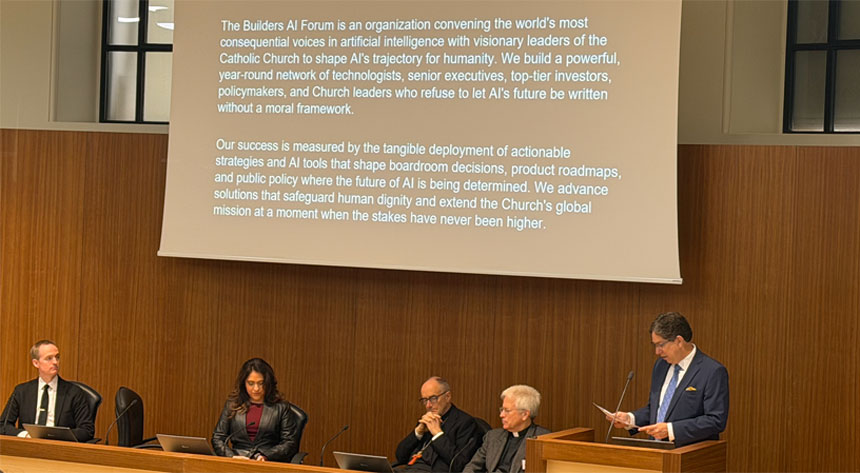
Around 300 Catholic business and religious leaders on AI gathered in Rome last week at the Builders AI Forum (BAIF), held November 5-6 at the Pontifical Gregorian University’s Collegium Maximum. It was the Forum’s third edition.
Representatives of 160 organizations from five continents, investors, researchers, policy advocates, and Church leaders spent two days discussing how Catholics could shape AI before AI shapes the world.
The program had a single gravitational center: Magnifica Humanitas, Pope Leo XIV’s encyclical on safeguarding the human person in the time of AI, signed on May 15 and released May 25.
Cardinal Michael Czerny, SJ, head of the Vatican’s inter-dicastery commission on artificial intelligence, called for a dialogue with the AI world in his opening remarks on Nov. 5, while wishing that AI would be used properly.
Vincent Higgins, CEO of the Builders AI Forum, framed the agenda around four areas: AI in evangelization, in healthcare, in education, and in the responsible building and scaling of AI itself.
The Dicastery for Communication’s prefect, Maria Montserrat “Montse” Alvarado, asked participants to consider “who we are supposed to be as we develop and shape this technology,” and urged them to “leverage the network through the people in this room.”
Erich Kerekes, founder and CEO of the Hallow app, said, “Prayer is fundamentally a relationship, coming before God, bringing your needs before him. That is something AI will never be able to come up with.”
Across workshop groups, and especially among entrepreneurs, the recurring technical consensus was the need to train models with reliable access to authoritative sources, rather than renting capability from providers whose defaults are set for a global market.
Matthew Harvey Sanders, CEO of Longbeard, the company behind Magisterium AI, put the mismatch in one sentence: “AI is designed to align with a billion people, which is an impossible task.” He advised builders: “Start from the world and what you want to build and work backward.”
Bishop Stephen Wang of the Diocese of Arundel and Brighton carried the argument into priestly formation. “The reality is so many people are discovering the faith or seeking answers to their questions through the internet, through AI; this is the starting point.”
One participant was Megan L. Garcia, who tragically lost her son, Sewell, to suicide after forming a romantic attachment with a chatbot last year. Speaking through her personal experience, she demanded accountability: “Who is responsible when AI hurts a child?” Garcia, founder of Blessed Mother Family Foundation, said companies need to participate in third-party release testing and ensure they cannot release, retain, or sell children’s data.
At the closing session, Cardinal Czerny suggested the Church’s first contribution is not a rulebook but a posture. “The first thing AI builders need to hear from the Church is that we’re listening,” he said. “If they feel accompanied, we’ll find a way together.”
The 2026 BAIF event produced no public communique, no published list of commitments, and no formal Vatican text. Participants described the format as deliberately working-level: problems named on day one, priorities and owners assigned on day two, with each workshop releasing a plenary report.
Pope Leo XIV also did not address this year’s Forum directly. His Nov. 3, 2025 message, which told builders that “technological innovation can be a form of participation in the divine act of creation,” remained the standing papal word to the gathering. That week, the Pope’s attention was elsewhere, on a South American journey that carried his AI teaching to the Catholic University of Uruguay, where he urged educators to put the person “before the algorithm.”
Discover more
IBL News is funded by the New York-based, family-owned company ibl.ai. Our stories adhere to the highest ethical standards in journalism and are available to news syndication agencies.