American Universities Continue to Lead Globally by Academic Field, According the QS Rankings
March 28, 2026
IBL News | Washington, D.C.
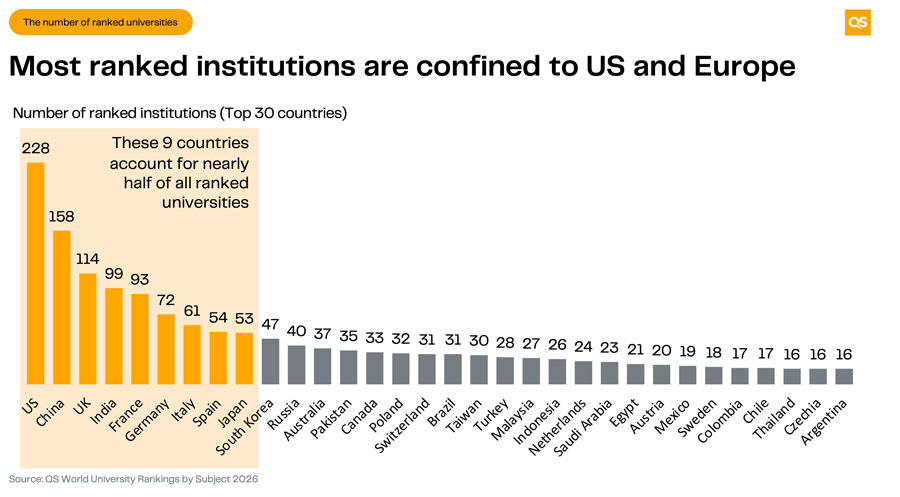
American universities continue to lead globally, with 228 ranked institutions — nearly double the next competitor — and the most number-one spots across academic disciplines worldwide, according to the QS World University Rankings by Subject 2026, released this week during the 2026 Global Skills Week in Washington, DC.
Another remarkable statistic is that just 9 countries account for roughly half of all ranked universities worldwide.
The top 10 by number of ranked institutions are:
1. 🇺🇸 United States — 228
2. 🇨🇳 China — 158
3. 🇬🇧 United Kingdom — 114
4. 🇮🇳 India — 99
5. 🇫🇷 France — 93
6. 🇩🇪 Germany — 72
7. 🇮🇹 Italy — 61
8. 🇪🇸 Spain — 54
9. 🇯🇵 Japan — 53
10. 🇰🇷 South Korea — 47
The most dramatic story in the data is China’s trajectory. In just four years (2022-2026), China went from 90 to 158 ranked institutions, a 75% increase. Other fast risers are:
• 🇰🇷 South Korea: 30 → 47 (+57%)
• 🇵🇰 Pakistan: 15 → 35 (+133%)
• 🇹🇷 Turkey: 15 → 28 (+87%)
• 🇮🇩 Indonesia: 12 → 26 (+117%)
• 🇸🇦 Saudi Arabia: 10 → 23 (+130%)
Notably, India has flatlined at 99 institutions since 2022, growing in number but not adding new ranked programs.
China alone contributed 34 new subject entries in 2026, with particular focus on Medicine (8), Chemistry (6), Economics (6), Computer Science (4), and Physics (4). India added 20, concentrated in Chemistry (5), Medicine (4), and Computer Science (4).
Both countries are making deliberate bets on STEM, and it’s showing in the rankings.
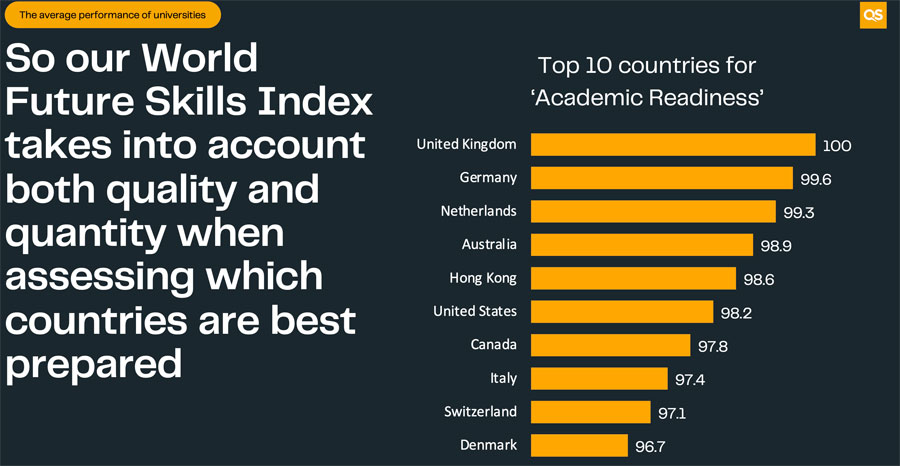
Through its World Future Skills Index, which weights both quality and quantity, QS formalized that the top 10 countries for “Academic Readiness” were:
1. 🇬🇧 United Kingdom — 100
2. 🇩🇰 Denmark — 99.6
3. 🇳🇱 Netherlands — 99.3
4. 🇦🇺 Australia — 98.9
5. 🇩🇪 Germany — 98.6
6. 🇭🇰 Hong Kong — 98.2
7. 🇺🇸 United States — 97.8
8. 🇨🇦 Canada — 97.4
9. 🇮🇹 Italy — 97.1
10. 🇨🇭 Switzerland — 96.7
Universities investing in AI programs have been climbing these rankings faster than traditional ones, signaling that the AI capability and institutional competitiveness game is now in the rankings.
QS is increasingly weighting “employer reputation” and “research citations” — both metrics where AI-focused universities are surging.
Per institutions, MIT dominates across 12 STEM subjects, including computer science, engineering, and data science. MIT has been ranked #1 overall for 14 consecutive years.
• Oxford — two departments are top in their subjects globally.
• FIU — hospitality ranked #3, politics top 15 among US public universities
• CU Boulder — ranked top 100 nationally in 25+ subjects, including computer science, engineering, business, law, and medicine
• University of Hawaii Mānoa — 14 programs recognized globally
In the ranking, data science & AI is now a standalone ranked subject — for the first time, QS treats it as a full discipline, not a subcategory of CS. This is significant because universities investing in AI programs now receive direct rewards in rankings.
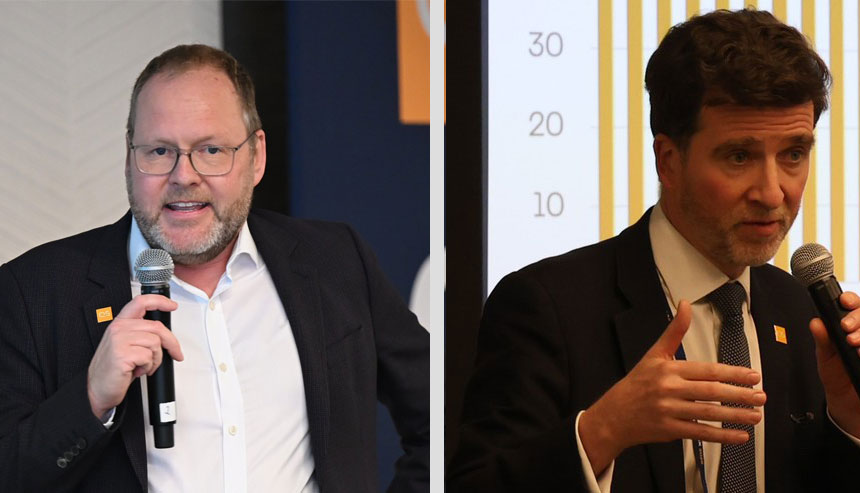
The ranking and its conclusions were presented by Leigh Kamolins, Vice President, Evaluation and Insights at QS Quacquarelli Symonds, and Jacques de Champchesnel, Head of Consulting, QS Quacquarelli Symonds, during the 2026 Global Skills Conference [in the picture above].
The session title was “How the Higher Education Sector is Rising to the Skills Challenge: The QS World University Rankings by Subject.” [Slides]
They both highlighted the US paradox: With over 200 institutions but a median score of less than 50, America has extraordinary peaks — MIT, Stanford, Harvard — but a very long tail of weaker programs that drag the average down. The US ranks 34th in median quality.
On AI readiness and who’s actually training the AI workforce, QS assessed countries on subjects that directly feed the AI and digital economy: Computer Science, Data Science, Engineering & Technology, Electrical Engineering, Mathematics, Statistics, Linguistics, Psychology, Business, Communication, Library Management, and Art & Design.
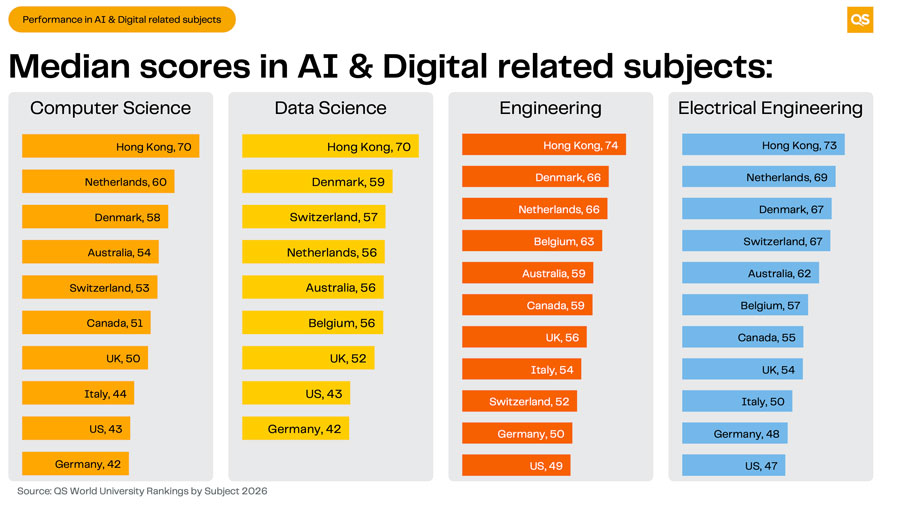
“The pattern is unmistakable: Hong Kong, the Netherlands, Denmark, and Australia consistently outperform the US in AI-related academic quality. The US ranks near the bottom of the top 10 in every single AI/digital category — 43 in Computer Science, 49 in Engineering, 47 in Electrical Engineering,” said the authors to IBL News.
The top 10 countries were:
Computer Science:
Hong Kong 70 → Netherlands 60 → Denmark 58 → Australia 54 → Switzerland 53 → Canada 51 → UK 50 → Italy 44 → US 43 → Germany 42
Data Science:
Hong Kong 70 → Denmark 59 → Switzerland 57 → Netherlands 56 → Australia 56 → Belgium 56 → UK 52 → Germany 42 → US 43
Engineering & Technology:
Hong Kong 74 → Denmark 66 → Netherlands 66 → Belgium 63 → Australia 59 → Canada 59 → UK 56 → Italy 54 → Switzerland 52 → Germany 50 → US 49
Electrical Engineering:
Hong Kong 73 → Netherlands 69 → Denmark 67 → Switzerland 67 → Australia 62 → Belgium 57 → Canada 55 → UK 54 → Italy 50 → Germany 48 → US 47
Leigh Kamolins and Jacques de Champchesnel highlighted the AI research explosion, as the number of AI publications in Computer Science grew from 100,000 in 2013 to 242,740 in 2023.
“Universities that aren’t investing in AI research infrastructure are falling behind in real-time.”
As key takeaways, these two QS researchers insisted on seven points:
1. Quantity ≠ Quality. The US has the most ranked universities in the world, but ranks 34th in median quality. As mentioned, having 228 programs means nothing if most of them underperform.
2. The real AI education leaders aren’t who you’d expect. Hong Kong, the Netherlands, and Denmark consistently outrank the U.S. in AI and digital subjects. Small, focused systems beat sprawling ones.
3. China is the fastest-growing force in global education. From 90 to 158 ranked institutions in 4 years, with a strategic focus on STEM. India has stalled.
4. Research impact is the differentiator. Countries that score highest in AI subjects aren’t just publishing more — they’re being cited more. Quality of research, not volume, is what separates the elite.
5. The UK is the world’s most balanced education system. #1 on the Future Skills Index for Academic Readiness — combining 114 institutions with consistently high quality across subjects.
6. AI publications have grown 143% in a decade, with 2023 seeing the biggest single-year jump (+20.8%) — driven by the generative AI boom.
7. Higher education is an economic policy. QS’s framing is explicit: countries that invest in AI-, digital-, and sustainability-focused academic programs are positioning themselves for long-term economic competitiveness. Universities are no longer optional infrastructure — they’re strategic national assets.
• “How the Higher Education Sector Is Rising to the Skills Challenge (PDF Presentation Slides)