ACT Summit Participants Discussed How AI Reshapes Testing, Credentials, and the Workforce
July 16, 2026
Mikel Amigot, IBL News | Nashville
Two weeks after ETS announced it would acquire ACT in a deal explicitly framed around AI, hundreds of education leaders gathered in Nashville for the 2026 ACT Summit in a three-day discussion about what readiness means in an economy where one-third of workers’ tasks already involve artificial intelligence tools.
The Summit, held July 13–15, brought together around six hundred K-12 administrators, community college presidents, state education officials, workforce professionals, and employers for over 60 sessions and four keynote plenaries.
On June 30, Educational Testing Service (ETS) — the Princeton, New Jersey-based nonprofit behind the GRE and TOEFL — announced it was acquiring ACT for an undisclosed amount. The combined entity will serve approximately 35 million people annually.
During the event in Nashville, Tennessee, ACT announced its Champion Awards and introduced the inaugural Work Ready Organization Awards, recognizing 11 institutions and employers, as well as 112 communities across 17 states.
Amit Sevak, CEO of ETS, spoke during the opening plenary session, stating: “Every student deserves a strong education, a fair shot at college, and a path to a good job. Together with ACT, we’re determined to serve students and parents along with educators and states by expanding access to education and job opportunities across America.”
Steve Tapp, who became ACT’s CEO in October 2025, acknowledged the limitations of going it alone: “Joining ETS gives us the platform to fulfill our mission at a scale we couldn’t reach alone.” He also noted, “The country is ready for the big change in education. There is no better time for measuring performance-based assessments”
ETS stated it has been investing in “AI-enabled measurement capabilities,” including AI-driven test-item generation, remote proctoring, and adaptive assessments. ACT had undergone a prior ownership change in April 2024 when private equity firm Nexus Capital Management converted the nonprofit to a for-profit public benefit corporation. That chapter lasted barely two years.
However, observers interviewed by IBL News showed concern about pricing power and competitive dynamics now that a single entity controls the ACT, GRE, TOEFL, and Praxis exams.
Not all educational leaders are welcoming the AI approach either. Over 36% of district leaders and teachers believe AI will worsen standardized testing within five years, with only 19% expecting improvement, according to a 2024 EdWeek Research Center survey.
The 2026 ACT Summit combined two previously separate events — the ACT Workforce Summit and the ACT Enrollment Management Summit — into a single cross-sector platform. The premise was that the boundaries between K-12, higher education, and workforce development have dissolved, and the conference format should reflect that.
“Communities across the country are navigating questions about college access, workforce participation, credential value, artificial intelligence, demographic shifts, economic mobility, and the future of learning itself,” Tapp stated.
Catherine Hofmann, ACT’s Senior Vice President of Government and Public Relations, added: “In a time of rapid change across education and workforce readiness, everything rises and falls on relationships.”
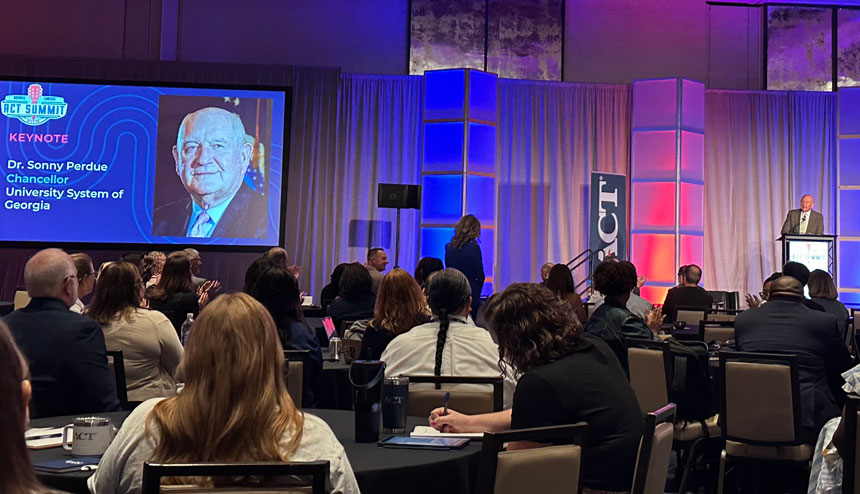
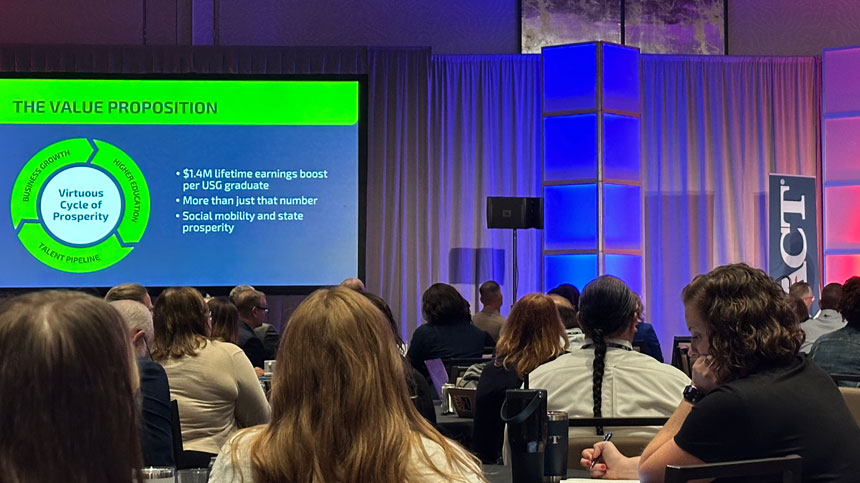
The plenary keynote was delivered by Dr. Sonny Perdue, Chancellor of the University System of Georgia, overseeing 25 public colleges, 382,000+ students, and a $12.1 billion annual budget. A former two-term governor and four-year U.S. Secretary of Agriculture, Perdue — who is retiring from the chancellorship at the end of 2026 — pushed back against narratives questioning the value of higher education.
“A college degree still matters. Now more than ever,” he proclaimed. “College is not an outdated luxury, but a public good, a workforce engine, and a pipeline of high-skilled talent.”
Perdue, who was granted a lifetime achievement award, argued that colleges develop “critical thinking, teamwork and adaptability — traits employers rank as more important than any single technical skill,” and noted, “by 2031, 72% of jobs will require postsecondary education, beyond high school, or training, and 42% will require a bachelor’s degree.”
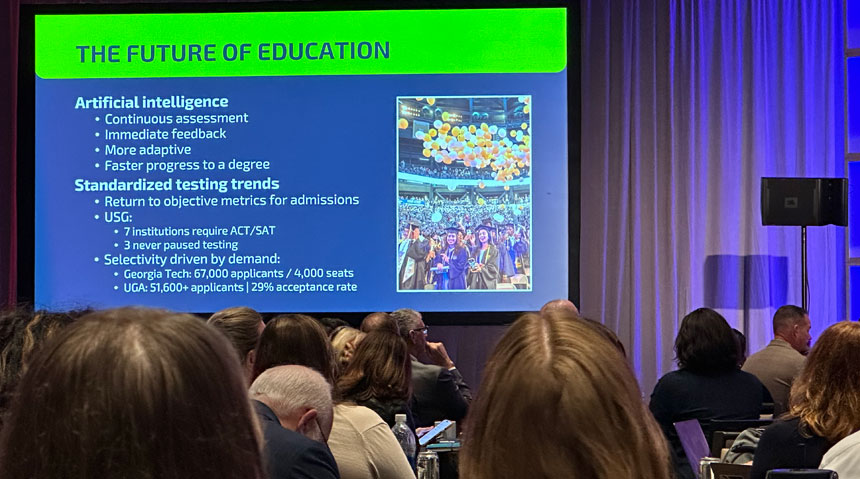
On AI specifically, Perdue said in July 2026 that higher education is essential for “preparing future leaders who will understand how to utilize emerging technologies like artificial intelligence effectively.” He characterized the university system as “part of a virtuous flywheel cycle of economic development.”
Dr. Anne Kress, president of Northern Virginia Community College, one of the nation’s largest community colleges, has emerged as a leading voice on AI’s impact on enrollment and workforce preparation. Regarding AI skills, she advocated for “durable skills for jobs, better aligned with the workforce.”
She added, “Students do not always need an AI degree, but they do need AI skill sets inside programs like healthcare, cybersecurity, skilled trades, and IT.” On the broader workforce outlook, Kress argued: “Students who come out ready to learn how to learn, to continually skill, re-skill, up-skill, cross-skill, they’re going to be fine.”
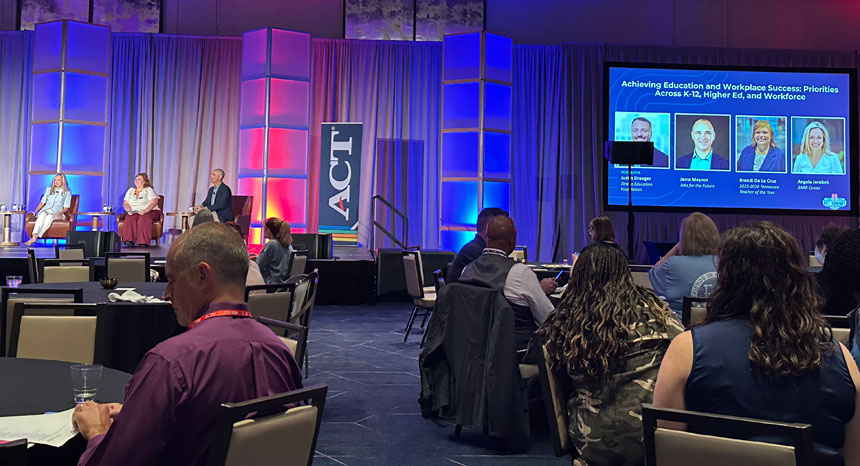
The classroom practitioner’s perspective was represented by Dr. Brandi De La Cruz, a secondary mathematics educator at Collierville High School and the 2025–26 Tennessee Teacher of the Year. Her belief was that “everybody can do math,” noting that “I bring people from the real world in and I bring examples from the real world in and show them that math is not a foreign language to them.”
On career readiness, she explained: “I don’t leave my classroom until I know the kids have learned and enjoyed their learning every single day.”
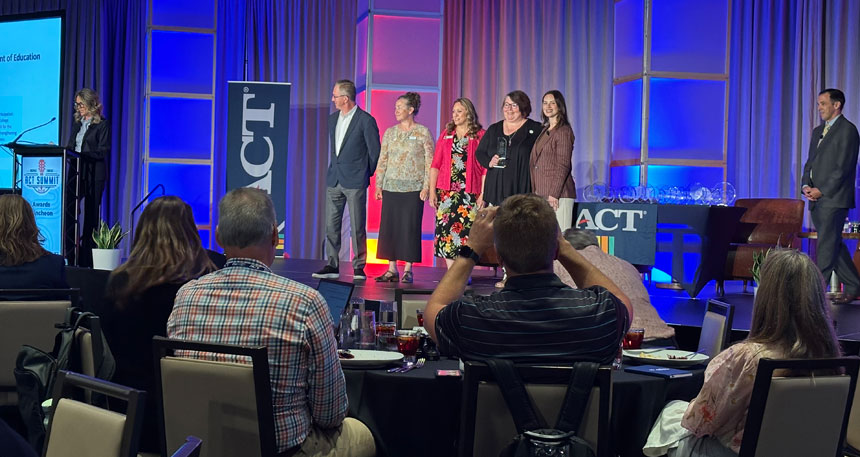
On Day 2, ACT presented six Champion Awards and five inaugural Work Ready Organization Awards. The recipients illustrate what ACT is becoming under ETS ownership: not primarily a test maker but a workforce-readiness platform.
Presenting the awards, Catherine Hofmann said, “Behind every one of these awards is a student who got a better shot because someone in their community chose to invest in them.”
Champion Awards:
- Wyoming State Dept. of Education (State College & Career) — Expanded WorkKeys access, partnered on NCRC college credit, English Learner assessment research.
- Gaston County Schools, NC (K-12 Policy) — Career readiness curriculum with WorkKeys integration and community employer partnerships.
- Metropolitan Community College, Omaha (Workforce Innovation) — Employer-aligned training with embedded WorkKeys across programs.
- Texarkana USA Chamber of Commerce (Workforce Policy) — WorkKeys in schools and employers across the TX-AR border, expanding to Northeast Texas.
- Butler County Community College, KS (Higher Ed 2-Year) — The only Kansas community college awarding college credit for the NCRC.
- University of Tennessee, Knoxville (Higher Ed 4-Year) — Transparent ACT score use in placement, Superscoring across sittings.
Inaugural Work Ready Organization Awards:
- Coastal Alabama Community College and Monroe 2 Orleans BOCES, NY (Adult Education Accelerators) — Coastal Alabama stacked NCRCs with industry credentials alongside Collins Aerospace. Monroe 2 Orleans BOCES awarded 85 NCRCs in 2025–26 and leads regional strategy through an ACT Advisory Council.
- RoyOMartin, Alexandria, LA (Employer of Choice) — The forestry manufacturer has embedded WorkKeys in hiring, advancement, and apprenticeships since 2011 and launched “Girls Can Too!” for inclusive talent pipeline development.
- CENLA, Central Louisiana Work Ready Network (Economic Development Catalyst) — 325+ employers engaged, NCRC data used in site-selection proposals.
- Brockport High School, NY (School of Excellence) — “Portraits with a Purpose” equity-focused model connecting classroom learning to career pathways.
Additionally, 112 communities across 17 states received Work Ready Community awards.
Artificial intelligence was not a standalone session track, but a gravitational field affecting every discussion — from credentialing and workforce readiness to assessment integrity and federal policy. The ETS’s 2026 Human Progress Report, surveying 32,000+ individuals across 18 countries, is quantifying the AI disruption:
- 77% of workers believe job security now depends on continuous skill development.
- 32% of tasks currently involve directing AI tools — expected to exceed 50% within two years.
- 60% feel pressured to adopt AI before they feel ready.
- 80% want certifications to verify their AI abilities; 73% struggle to understand the level employers expect.
- 82% say industry-specific AI competency standards would help identify which skills matter.
The report’s central finding highlights that adaptability — not any single technical skill — is the new foundation for job security.
The ACT Summit coincided with rapid legislative movement on AI in education:
- NSF AI Education Act of 2026 (Sens. Cantwell, Moran): K-12 AI playbooks, NSF educator fellowships, AI access for rural schools and minority-serving institutions.
- K-12 AI Literacy and Readiness Act of 2026 (Rep. Fine): preparing students and teachers for an AI-driven economy.
- U.S. DOL “Make America AI-Ready” (March 2026): free AI literacy via text message to American workers.
- U.S. DOL AI Apprenticeship Initiative (April 2026): integrating AI skills into Registered Apprenticeship programs.
- California “AI-Ready California” (launched July 14, the same day as Summit Day 2): first-in-nation AI literacy micro-credential with workforce and civics tracks.
- SKILL Act (June 2026): employer tax credits for AI training partnerships with colleges.
At the other end of the spectrum, a Senate report from Sen. Bernie Sanders warned that AI could eliminate nearly 100 million U.S. jobs over the next decade.
The top speakers assembled in Nashville noted that the K-career landscape continues to shift as AI transforms jobs, technology reshapes access, and students seek clearer postsecondary pathways. They agreed that today’s essential skills are critical thinking, teamwork, and adaptability, along with skill sets within programs such as healthcare, cybersecurity, skilled trades, and IT.
On the Summit’s final day, organizers announced that the 2027 ACT Conference will take place July 12–14, 2027, in New Orleans, signaling that the convening mission will continue beyond the ETS acquisition.
The choice of Louisiana, home to some of ACT’s deepest workforce partnerships, including RoyOMartin and the CENLA Work Ready Network, underscores the organization’s pivot toward workforce credentialing.