Pope Leo XIV Urges Global Leaders To Establish Binding Frameworks to Control AI
September 28, 2026
IBL News | New York
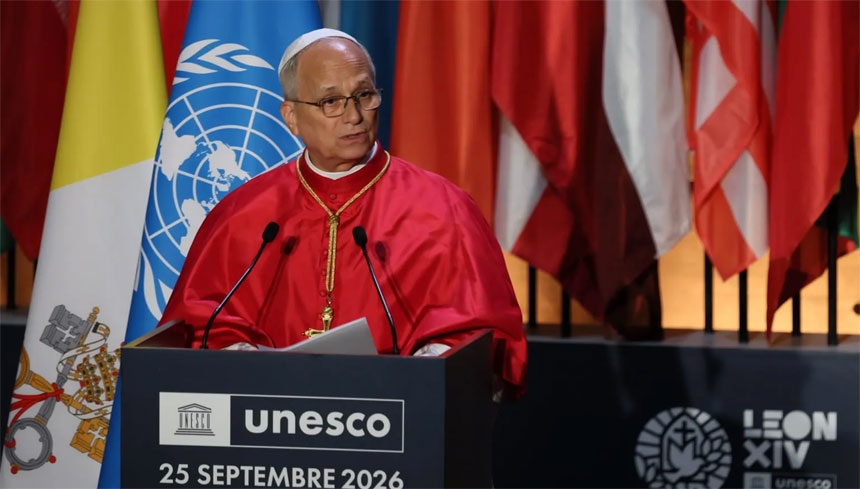
Speaking to an audience of over 1,400 diplomats, scientists, and cultural representatives at UNESCO Headquarters in Paris, Pope Leo XIV warned of the dangers that the rapid rise of AI poses to human dignity, positioning the Vatican at the center of the global debate on digital ethics.
In a major philosophical address, Leo XIV argued that humanity is outsourcing the one thing it can’t afford to lose: moral responsibility.
The Pontiff said that machines can process information but can never replicate humanity’s moral responsibility, highlighting the boundary between computational power and human intellect.
He challenged the notion that advanced algorithms could ever serve as a substitute for human intuition, creativity, or moral judgment.
“Information alone cannot cultivate truth,” Pope Leo XIV stated. He argued that while AI can analyze vast datasets at unprecedented speeds, it lacks the capacity to provide the deeper meaning, empathy, and trust that form the foundation of human society. “Meaning is the oxygen of the mind.”
Pope Leo XIV urged international bodies to move beyond voluntary guidelines and establish binding frameworks rooted in what the Vatican calls “algor-ethics”—the ethical development of algorithms.
• Preserving Human Agency: He insisted that lethal autonomous weapons systems and automated judicial sentencing must be strictly regulated to ensure a human always makes the final, morally binding decision.
• Countering Digital Colonialism: The Pope warned that unequal access to AI technologies threatens to widen the gap between wealthy nations and the Global South, creating new forms of economic and intellectual marginalization.
• Protecting the Youth and the Most Vulnerable: He expressed deep concern over how algorithmic feeds shape the minds of younger generations, urging UNESCO to prioritize educational models that foster critical thinking over digital dependency.
Following his tech-focused encyclical, Magnifica Humanitas, released in May, the Pope targeted the industry’s obsession with scaling laws and compute metrics, noting the deep irony that we now routinely call artificial systems “intelligent” while treating actual human beings as friction.
Days before the Pope took the stage in Paris, President Trump struck a radically different tone during his own address at the United Nations. Dismissing highly restrictive AI safety guardrails as a “hoax” designed to stifle economic growth, Trump insisted that the U.S. would not hobble its own tech industry while competing globally.
While Trump noted the Justice Department would monitor the sector for major disruptions, his message was clear: acceleration is the priority.
Silicon Valley tech elites are quietly echoing the White House position, and venture capitalists and tech executives view the Vatican’s demand for legally binding international “algor-ethics” frameworks as unworkable, rejecting top-down, religiously informed restrictions.
*
Discover more
IBL News is funded by the New York-based, family-owned company ibl.ai. Our stories adhere to the highest ethical standards in journalism and are available to news syndication agencies.