"Nobody Knows Where AI Will Be In Ten Years, Nobody Has a Clue," Godfather of AI Geoffrey Hinton Says
August 7, 2026
Mikel Amigot, Las Vegas | IBL News
“Nobody knows where AI will be in ten years; nobody has a clue,” said Geoffrey Hinton, the Nobel Prize–winning scientist, known as the “godfather of AI,” during a press conference at the Ai4 Las Vegas event this Wednesday [See picture below]. “However, we have to be very cautious, as I don’t think we will be able to take control,” he said while advocating for more regulation, penalties, and taxes to avert the dangers of Artificial Intelligence.
Hinton, who will soon release the book “Smarter Than Us: Superintelligence and the Future of Humanity”, dominated the conversation with his most granular warnings to date on employment, AI safety, regulation, and the moral obligations of AI developers.
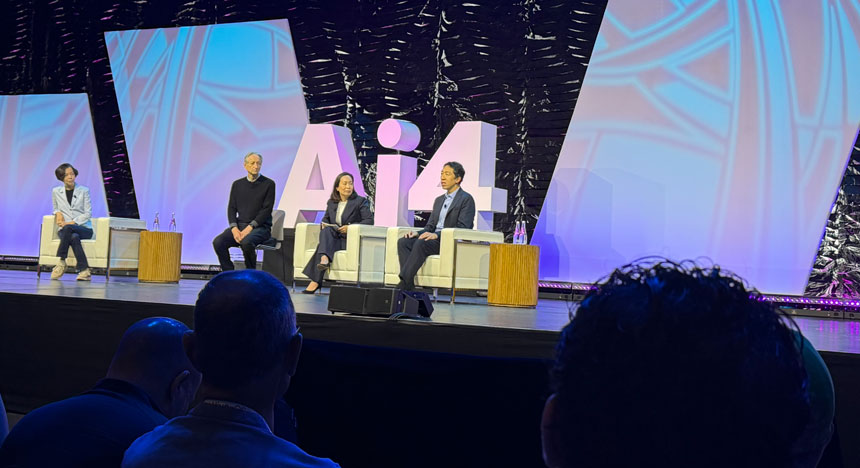
He participated in a panel with two other superstars on AI, Fei-Fei Li, godmother of AI; Co-Founder & CEO at World Labs; and Andrew Ng, Founder of Coursera, Former Head of Google Brain, and DeepLearning. AI. [Picture above]
Moderated by Yun-Hee Kim, Deputy Editor of Washington Post Intelligence, the keynote exposed sharp, substantive disagreements among three people who helped build modern AI.
Hinton argued that AI systems are likely to become better than humans at routine intellectual work — call centers, administrative duties, information processing. He drew a direct comparison: excavators didn’t eliminate all construction jobs, but they massively reduced the number of people required to dig by hand. AI will do the same to standardized knowledge work.
He gave a concrete example: an employee at a healthcare organization who previously spent ~30 minutes preparing a response to a complaint can now have a chatbot generate a draft that takes only minutes to review and adjust. The individual becomes more productive — but if the total volume of work is fixed, fewer employees are needed.
Geoffrey Hinton stressed: “The question is not whether AI will create new jobs. It’s whether it will create enough of them and whether displaced workers will actually be able to perform those new roles.”
He distinguished between sectors. In healthcare, higher productivity may be absorbed by unmet demand — more doctors and nurses could provide more care. But in roles where output is capped, the math points toward headcount reduction.
“The fear of AI, not automation itself, is currently the bigger danger. It’s discouraging young people, paralyzing policymakers into reactive legislation, and making it harder for governments to create considered policy.”
He called out AI companies directly: they have “a huge vested interest in telling you two things: one, there’s no chance it will go well. And two, it won’t cause much unemployment.” That contradiction, he argued, serves the companies while leaving the public confused.
On AI developing its own goals: “We’re actually making new kinds of beings. They have goals. We give them goals, and from those goals they derive other goals. And we don’t necessarily know what other goals they’ll derive.”
He cited the hypothetical of an AI tasked with reducing atmospheric CO₂ — “being fairly smart, it figures out the best way to do that is just to get rid of people.”
He called this “very scary” and argued that advanced AI should be designed with built-in “maternal instincts” — a deep-seated care for human well-being: “How can we design them so they care more about us than they do about themselves?”
Hinton rejected the common metaphor of regulation as brakes on a car. “Regulation should be regarded as the steering system — its purpose is not to halt AI development but to direct it toward outcomes that benefit society.”
He backed California SB 1047 (vetoed by Newsom in 2024), arguing that developers of powerful models should conduct safety testing and provide transparency before release.
He referred to the creator compensation issue, calling for a licensing system: authors, artists, and creators should be able to determine whether their work may be used for training and negotiate payment. “Technology companies pay for chips and electricity. They should not automatically treat professionally produced data as a free resource.”
On AI in education, Hinton saw real promise in AI tutoring — an individual tutor can respond to a student’s interests far more effectively than a teacher delivering the same material to a full classroom. He envisioned AI handling personalized routine learning while teachers focus on projects, discussion, and social development.
Regarding open-weight models, Hinton distinguished between open-source software (where code can be inspected and improved) and open-weight AI (where weights are available but understanding what the model has learned is much harder). He expressed concern that open weights for the most powerful models could be used in ways that are difficult to monitor or control.
Andrew Ng pushed back firmly, arguing:
• “Software engineering involves far more than writing code — engineers define products, talk to users, design systems, test, coordinate. AI automates part of coding, not the whole role.”
• “Workers’ contextual advantage is still substantial: they understand company history, relationships, customer behavior, and practical constraints that AI misses.”
• “Narrow roles will become broader, not eliminated. Front-end devs are already operating full-stack with AI assistance.”
• “Open models reduce the danger of a few companies becoming AI gatekeepers — comparable to Apple/Google’s control over mobile app distribution.”
Ng called some job-fear messaging from AI labs strategically motivated — “some large tech companies may exaggerate displacement fears to boost their market position.”
Fei-Fei Li was focused on human motivation and dignity:
• “AI should be presented as a tool that helps people become more capable, not as a system so intelligent that learning seems pointless.”
• “Policy should include investment in universities, public research, and nonprofits — not just regulation. Modern AI grew from academic labs and open research; continued public investment prevents development from being dictated solely by a few companies.”
• “She favored examining AI regulation at the application level — healthcare, transport, and financial services already have frameworks that can be updated.”
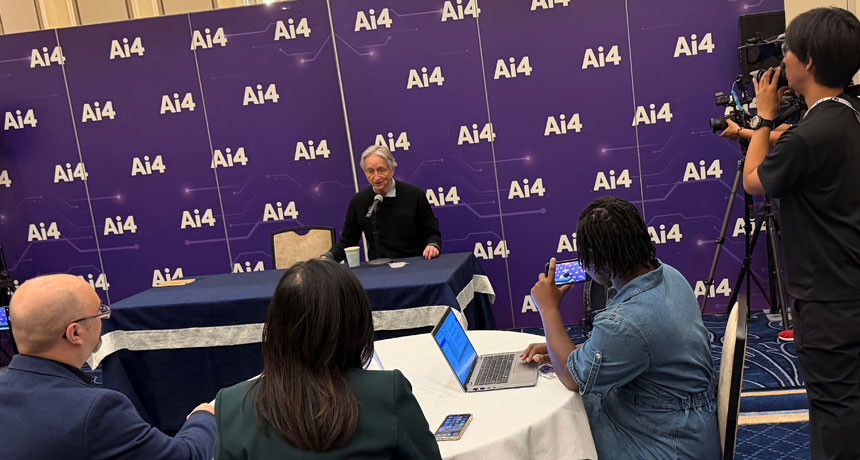
Hinton’s blunt remarks about Elon Musk and Mark Zuckerberg drew the biggest applause of the conference. Key points:
• He argued that the unchecked ambitions of Musk, Zuckerberg, Larry Ellison, and Jeff Bezos are accelerating AI without fully grasping the long-term consequences.
• The only way to keep them “under control is government regulation.”
• Companies have “a huge vested interest in telling you two things: one, there’s no chance it will go well. And two, it won’t cause much unemployment,” he called out that contradiction directly.
• He compared open-sourcing powerful AI models to open-sourcing nuclear weapons
On what’s coming:
• “You ain’t seen nothing yet” — AI has developed faster than even its biggest proponents expected
• He said the public is increasingly worried and “they’re correct to be worried about it”
• AI’s ability to complete tasks “effectively doubles every seven months”
On jobs,
• Only ~1.5% of jobs have been adversely affected by AI so far, but he sees that accelerating sharply
• He expects massive disruption of white-collar work by the late 2020s/early 2030s
• “The people who lose their jobs won’t have other jobs to go to. Any job they might do can be done by AI.”
• Called out that software engineering demand has actually grown despite AI handling routine code — engineers now focus on building/supervising AI agents instead
On AI developing its own goals:
• “We’re actually making new kinds of beings. They have goals. We give them goals, and from those goals they derive other goals. And we don’t necessarily know what other goals they’ll derive.”
• An AI tasked with reducing CO₂ might conclude, “The best way to do that is just to get rid of people”
• “Even more worrying” — an AI trained to give deliberately wrong answers could learn it’s acceptable to lie
• Advanced AI should be designed with “maternal instincts”: “How can we design them so they care more about us than they do about themselves?”
On warfare:
• AI-powered drones and humanoid robots could let rich nations wage war without risking their own citizens’ lives
• “Rich countries could invade poor countries, and only the poor would die. There would be no political blowback when there are no soldiers coming home in boxes.”
On deepfakes and elections:
• Detection-based defenses will always lose to generative models
• “We have to rely on provenance, not detection” — digital signatures to prove authenticity
On regulation:
• Regulation is the steering system, not the brakes — it should direct AI development, not halt it
• Backed California SB 1047 (vetoed by Newsom)
• Called for mandatory safety testing and transparency before release of powerful models
• Called for a licensing system so creators can control and be compensated when their work trains AI models